Source page 1
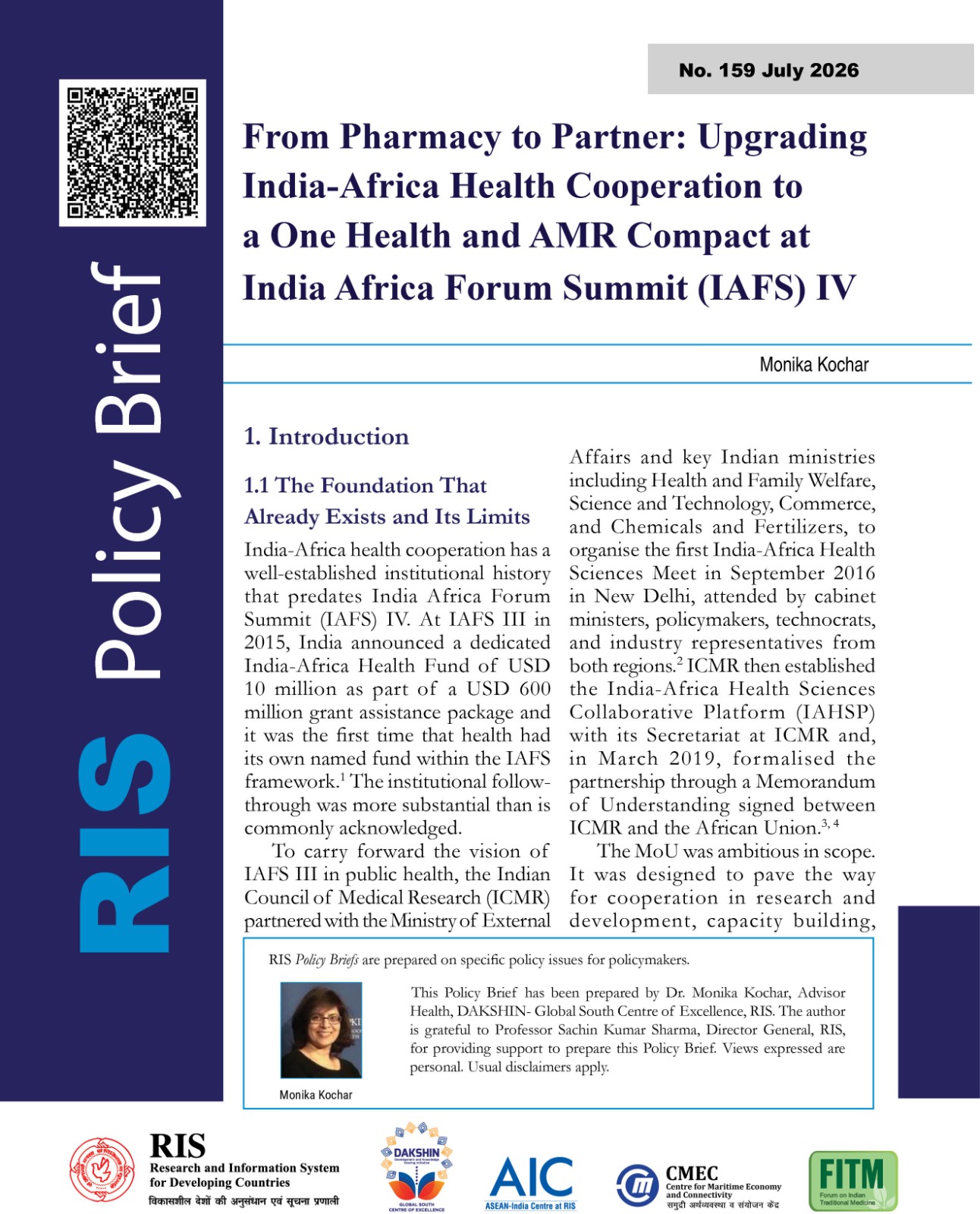
RIS No. 159 July 2026 From Pharmacy to Partner: Upgrading India-Africa Health Cooperation to a One Health and AMR Compact at India Africa Forum Summit (IAFS) IV Policy Brief Monika Kochar 1. Introduction 1.1 The Foundation That Already Exists and Its Limits India-Africa health cooperation has a well-established institutional history that predates India Africa Forum Summit (IAFS) IV . At IAFS III in 2015, India announced a dedicated India-Africa Health Fund of USD 10 million as part of a USD 600 million grant assistance package and it was the first time that health had its own named fund within the IAFS framework.1 The institutional follow- through was more substantial than is commonly acknowledged. To carry forward the vision of IAFS III in public health, the Indian Council of Medical Research (ICMR) partnered with the Ministry of External Affairs and key Indian ministries including Health and Family Welfare, Science and Technology, Commerce, and Chemicals and Fertilizers, to organise the first India-Africa Health Sciences Meet in September 2016 in New Delhi, attended by cabinet ministers, policymakers, technocrats, and industry representatives from both regions.2 ICMR then established the India-Africa Health Sciences Collaborative Platform (IAHSP) with its Secretariat at ICMR and, in March 2019, formalised the partnership through a Memorandum of Understanding signed between ICMR and the African Union.3, 4 The MoU was ambitious in scope. It was designed to pave the way for cooperation in research and development, capacity building, FITM Forum on Indian Traditional Medicine Monika Kochar RIS Policy Briefs are prepared on specific policy issues for policymakers. This Policy Brief has been prepared by Dr. Monika Kochar, Advisor Health, DAKSHIN- Global South Centre of Excellence, RIS. The author is grateful to Professor Sachin Kumar Sharma, Director General, RIS, for providing support to prepare this Policy Brief. Views expressed are personal. Usual disclaimers apply.
Source page 2
2 RIS Policy Brief # 159 health services, and pharmaceutical trade and manufacturing capabilities for drugs and diagnostics. 4 In its first operational year, seven training courses were conducted across three ICMR institutes, providing training to 95 African health practitioners and researchers from 26 African countries.2 The three IAFS cycles between 2008 and 2015 established health as a named sector within India’s development partnership with Africa. The IAFS III framework marked the first explicit financial commitment to health – a dedicated India-Africa Health Fund of USD 10 million – alongside the broader USD 600 million grant packages.1 The sectoral composition of Lines of Credit over this period reflected the infrastructure priorities of the time, with roads, energy, and agriculture absorbing the bulk of financing.5 Health, while present, remained a residual rather than a strategic priority in LOC allocations across all three cycles. IAFS IV presents the opportunity to rebalance that portfolio. With both India and Africa having now formalized comprehensive health governance frameworks – NAP-AMR 2.0 and the AU AMR Framework 2.0 respectively - the conditions exist to make health not simply a named sector but a structural anchor of the bilateral development relationship. This brief is to take stock of developments and suggest the way forward while learning lessons. The IAHSP is an institutional achievement, the first formal research compact between ICMR and the AU. However, a research and training platform is not pandemic preparedness architecture. IAFS IV is positioned to convert the former into the latter. 1.2 The Stakes: Why AMR, Why Now Antimicrobial resistance (AMR) is the slow pandemic that both India and Africa are most poorly equipped to handle and most jointly positioned to address. In the WHO African region, over 1.05 million deaths were associated with AMR and 250,000 were directly attributable to it in 2019. The AMR mortality exceeds both HIV/AIDS and malaria mortality in the same region.6 Figures vary across studies depending on geographic scope and pathogen classification: regional estimates for the WHO African region place direct AMR mortality at 250,000, 6 while continent-wide analyses using 1 Ministry of External Af- fairs, Government of India. (2015). Third India- Africa Forum Summit 2015: Delhi Declaration 2015 and India-Africa Framework for Strategic Cooperation. https:// mea.gov.in/india-africa- forum-summit-2015/ 2 Indian Council of Medical Research. (n.d.). India-Africa Health Sci- ences Platform (IAHSP). https://www.icmr.gov. in/india-africa-health- sciences-platform-iahsp 3 Ministry of External Affairs, Government of India. (2019, March 27). Memorandum of Understanding on India- Africa health sciences cooperation between ICMR and the African Union. https://www. mea.gov.in/press-releases. htm?dtl/31184/ 4 Beri, R. (2015). India-Af- rica partnership in health care: Accomplishments and prospects. Research and Information System for Developing Countries. https://www.ris.org.in/ sites/default/files/Publi- cation/India_Africa_Part- nership_in_Healthcare. pdf 5 Kurian, O. C. (2020, Oc- tober 5). India's lines of credit to Africa in health: Opportunity to build a key pillar to the economy. Observer Research Foun- dation. https://www.or- fonline.org/expert-speak/ indias-lines-of-credit-to- africa-in-health-opportu- nity-to-build-a-key-pillar- to-the-economy-74535 6 Ayobami, A., Bielicki, J., Heupink, T. H., & Van Boeckel, T. P . (2024). The burden of bacterial antimicrobial resistance in the WHO African region in 2019: A cross-country IAFS Cycle LOC Committed Health-Specific Commitment Dominant LOC Sectors IAFS I (2008) USD 5.4 billion NA Roads, railways, power, ports IAFS II (2011) USD 5 billion NA Energy, education, telecom, agriculture IAFS III (2015) USD 10 billion USD 10 million India-Africa Health Fund Roads, power, agriculture, health (limited) Total IAFS Commitments (2008-2015) USD 20.4 billion USD 10 million Infrastructure and energy dominated portfolio
Source page 3
3 RIS Policy Brief # 159 a broader pathogen scope estimate 860,000 deaths directly attributable to drug-resistant bacterial infections in the same year, 7 Without decisive action, sub-Saharan Africa is projected to face 4.1 million AMR-related deaths annually by 2050.7 Sub-Saharan Africa and South Asia together account for the highest rates of attributable and associated AMR deaths globally, with a particularly high burden from multi- drug resistant tuberculosis.7 India's domestic trajectory points in the same direction. India launched NAP- AMR 2.0 (2025-2029) in November 2025, employing a comprehensive One Health approach covering human, animal, agriculture, and environmental sectors.8, 9 The updated plan includes specific action plans for each key stakeholder ministry and department, with timelines and budgets, and involves participation from over 20 ministries and departments.9 On the African side, Africa CDC convened a continental consultation in October 2025 to finalise a strengthened AU AMR Framework 2.0, guiding continental implementation from 2026 to 2030.10 Both regions have simultaneously upgraded their domestic AMR frameworks. IAFS IV arrives at a moment when the proposed bilateral compact would have two live policy architectures to anchor it. 1.3 Why IAFS IV Is the Decisive Window 1.3.1 The IA SPIRIT Theme Creates Explicit Mandate Innovation, Resilience, and Inclusive Transformation are not rhetorical aspirations, they describe precisely what a One Health and AMR Compact would operationalize. Pandemic preparedness through shared governance architecture is a substantive expression of resilience for IAFS IV health deliverable.11 1.3.2 Africa CDC's Presence as IAFS IV Partner Is Consequential Africa CDC's One Health Programme serves as the institutional platform for advancing multisectoral collaboration across human, animal, and environmental health, providing an enabling framework for continental AMR coordination and surveillance.12 Africa CDC co-chairs the Africa Coordinating Group for AMR control alongside IBAR, regional economic communities, WHO, FAO, and the World Organisation for Animal Health (WOAH), and conducts continental event-based surveillance for public health events involving both humans and animals.13 Its presence at IAFS IV as a formal partner organisation means that at least one of the Compact's key institutional interlocutors is already engaged in the Summit process, which is a more favourable starting condition than many comparable initiatives have had. 1.3.3 The Geopolitical Window Is Closing External health aid to Africa has dropped by nearly 70 per cent since 2021, even as disease outbreaks increased by more than 40 per cent between 2022 and 2024.13 Traditional donor countries, particularly members of the OECD Development Assistance Committee (DAC), are reassessing development cooperation priorities amid mounting fiscal pressures. Recent OECD analyses indicate that several major donors have announced reductions in official development systematic analysis. The Lancet Infectious Diseases, 24(2), 176-194. https:// doi.org/10.1016/S1473- 3099(23)00539-9 7 Ikuta, K. S., Swetschin- ski, L. R., Aguilar, G. R., Sharara, F., & Naghavi, M. (2024). Global burden of bacterial antimicrobial resistance 1990-2021: A systematic analysis with forecasts to 2050. The Lan- cet, 404(10459), 1199-1226. https://doi.org/10.1016/ S0140-6736(24)01867-1 8 National Centre for Dis- ease Control, Ministry of Health and Family Welfare, Government of India. (2025). National action plan on antimicrobial re- sistance (NAP-AMR) 2.0 (2025-2029). Directorate General of Health Services. https://www.dghs.mohfw. gov.in/uploads/assets/ KXmRi1l4QdT6LYh- FCyNh734zJJsO62yW- zL05FVKv.pdf 9 Press Information Bureau, Ministry of Health and Family Welfare, Govern- ment of India. (2025, No- vember 18). Union Health Minister Shri JP Nadda launches National Action Plan on Antimicrobial Re- sistance 2.0. https://www. pib.gov.in/PressReleaseP- age.aspx?PRID=2191165 10 Africa Centres for Disease Control and Prevention. (2025, November 7). Africa CDC pushes for country-level action in version 2.0 of the African Union Framework for AMR (2026-2030). https:// africacdc.org/news-item/ africa-cdc-pushes-for- country-level-action-in- version-2-0-of-the-african- union-framework-for- amr-2026-2030/ 11 Ministry of External Af- fairs, Government of India. (2026, April 23). Fourth India-Africa Fo-
Source page 4
4 RIS Policy Brief # 159 assistance, with overall aid flows projected to decline further through 2027, potentially affecting health and development financing in Africa. 5,15 The European Union has already moved into this vacuum, launching three new AU-Africa CDC health partnership initiatives worth over 100 million Euros under its Global Gateway strategy, explicitly covering One Health, AMR prevention, detection and response, and digital health solutions. 15 India brings real comparative strengths to this relationship: non-conditionality in its development partnerships, an established generic medicines supply chain, an exportable DPI architecture, and a postcolonial solidarity that carries weight in African diplomatic contexts. 2. The Case for a Compact, Not a Project The IAHSP experience teaches a clear lesson: research and training platforms, however well-designed, do not constitute pandemic preparedness architecture. They are inputs, not outcomes. A Compact is differentiated from a platform in three substantive ways. • Governance instrument - AMR requires greater coordination, political leadership, and interdisciplinary multisectoral action across the human-animal- plant-environmental interface to safeguard planetary health.16, 17 A governance compact can produce this accountability structure as compared to a training platform. • Demand-driven - The Compact must be structured around African-defined priorities, aligned with the AU's Agenda 2063 and the AU AMR Framework 2.0, not India's pharmaceutical export interests. Africa CDC has underscored that while nearly 47 African countries have developed national AMR action plans, most are unfunded, and governments were urged to embed AMR within domestic budgets rather than relying on aid cycles.10 • Public good – The outputs of the compact including surveillance data, stewardship protocols, DPI platforms, and genomics capacity are non-rivalrous and accessible to all AU member states. India's G20 Presidency explicitly kept tuberculosis, AMR, and the One Health approach on its health agenda, aiming to promote multilateral health cooperation and collective action. 18 The Compact builds on this multilateral vocabulary and extends it into a bilateral governance instrument. 2.1 Architecture of the Compact - The Three Pillars Pillar I: One Health Surveillance and Integrated Data Sharing The Compact's first pillar would formally link India's ICMR AMR Surveillance and Research Network with Africa CDC's continental disease intelligence architecture, establishing a Joint India-Africa One Health Surveillance Network for real-time, cross-border tracking of resistant pathogens across human, animal, and environmental interfaces. Africa CDC has noted that since COVID-19, the continent has expanded from just two countries capable of pathogen sequencing to around 41, rum Summit. https:// www.mea.gov.in/press- releases?dtl/41073/ Fourth_IndiaAfrica_Fo- rum_Summit 12 Africa Centres for Disease Control and Prevention. (n.d.). One Health programme. https://africacdc. org/programme/ surveillance-disease- intelligence/one-health/ 13 Africa Centres for Disease Control and Prevention. (2025, No- vember 21). Africa CDC unveils a new vision for health security and sovereignty across the continent. https://afri- cacdc.org/news-item/ africa-cdc-unveils-a- new-vision-for-health- security-and-sovereignty- across-the-continent/ 14 Organisation for Eco- nomic Co-operation and Development. (2025). Cuts in official develop- ment assistance. OECD Publishing. https:// www.oecd.org/en/ publications/cuts-in- official-development- assistance_8c530629-en/ full-report 15 European External Action Service. (2025, April). AU and EU strengthen their health partnership, launch initiatives under Global Gateway. https://www. eeas.europa.eu/delega- tions/african-union-au/ au-and-eu-strengthen- their-health-partnership- launch-initiatives-under- global-gateway_en 16 Altevogt, B. M., Taylor, P ., Akwar, H. T., Gra- ham, D. W ., Ogilvie, L. A., Duffy, E., & Essack, S. Y . (2025). A One Health framework for global and local steward-
Source page 5
5 RIS Policy Brief # 159 opening doors for genomics-enabled surveillance against AMR threats. 10 India's bioinformatics and genomics capacity across ICMR, CSIR, and the Genome India initiative can directly accelerate African sequencing capability through technology transfer rather than aid transfer. This pillar operationalizes the emerging and re- emerging infections mandate that was already written into the 2019 ICMR- AU MoU but never specifically acted upon for AMR.3 Pillar II: AMR Stewardship and Pharmaceutical Cooperation India supplies over 50 per cent of global generic medicine demand. Africa bears the highest AMR mortality burden of any WHO region despite having some of the lowest rates of antibiotic resistance prevalence - a paradox driven by underlying infectious disease burden and weak health systems, not excessive antibiotic use. A comprehensive One Health stewardship framework must address the full antimicrobial lifecycle, from research and development, production, and registration through procurement, appropriate use, and disposal, requiring coordinated global and local policy action at every stage.16 The Compact would formalise this lifecycle approach across several interconnected areas. Joint antibiotic stewardship guidelines, adapted to low-resource settings, would form the clinical foundation. Technology transfer for local antibiotic manufacturing in Africa, channelled through India's existing Lines of Credit architecture, would address the production gap. Alignment of pharmacovigilance standards across both regions would strengthen post- market safety monitoring. Direct support for African countries in developing and implementing their national AMR action plans, drawing on India's NAP-AMR 2.0 experience, would close the policy implementation gap that has left most African national plans unfunded and inoperative.9 The 2019 MoU established the normative framework for precisely this kind of cooperation; what it did not provide was the governance architecture to operationalise it. That gap is what the Compact proposed here seeks to address. Pillar III: Digital Public Infrastructure and AI as Enabling Layer This pillar distinguishes the Compact from all antecedent India-Africa health initiatives. India's Pan-African e-Network and e-VBAB projects already offer tele-education and telemedicine services, and India has signed MoUs on India Stack with seven African countries, covering digital identity and Digital Public Infrastructure implementation. 19, 20 The Compact would upgrade the e-AarogyaBharati telemedicine platform from a project into a DPI layer that is open-source, interoperable, and locally governable by African health ministries. Expanding digital health tools and advanced diagnostics was identified as a priority step in improving AMR surveillance, stewardship, and response at the India AMR Partners Meeting in Delhi in February 2025. 20 The Modular Open Source Identity Platform (MOSIP), already partnering with 19 African countries on digital identity, provides the foundational ship across the antimicro- bial lifecycle. Communica- tions Medicine, 5, 414. https://doi.org/10.1038/ s43856-025-01090-4 17 Quadripartite Joint Sec- retariat on AMR. (n.d.). Multi-stakeholder partner- ship platform on AMR: Our work. https://www. qjsamr.org/multistakehold- er-partnership-platform/ our-work 18 Indian Council of World Affairs, Government of India. (n.d.). Adopting One Health approach for a better pandemic pre- paredness. https://www. icwa.in/show_content. php?lang=1&level=3&ls_ id=12124&lid=7392 19 Press Information Bureau, Government of India. (2026, March 31). Govern- ment's initiatives for global cooperation on Digital Public Infrastructure (DPI). https://www.pib. gov.in/PressReleasePage. aspx?PRID=2235812 20 Ministry of External Af- fairs, Government of India. (2025, January 7). India–Seychelles joint vision for sustainability, economic growth and se- curity through enhanced linkages (SESEL). https:// www.mea.gov.in/bilateral- documents?dtl/40719/ India__Seychelles_Joint_ Vision_for_Sustainabil- ity_Economic_Growth_ and_Security_through_En- hanced_Linkages_SESEL 21 ReAct Asia Pacific. (2025, March). India: Strength- ening partnerships for stronger action on AMR. https://www.reactgroup. org/news-and-views/ news-and-opinions/ year-2025/india-strength- ening-partnerships-for- stronger-action-on-amr/
Source page 6
6 RIS Policy Brief # 159 infrastructure for health beneficiary tracking without requiring new architecture.21 3. Conclusion Eleven years after IAFS III created the India-Africa Health Fund and seven years after the ICMR-AU MoU established the IAHSP , the India- Africa health relationship has a solid foundation and an unfulfilled promise. The IAHSP demonstrated that structured health cooperation between India and the AU is institutionally possible. The missing element has consistently been governance architecture capable of operating at the scale of shared pandemic risk. The Compact proposed here is best understood as the institutional maturation of a relationship that has long had the right foundations but lacked the right framework. AMR kills more Africans than HIV or malaria, 6, 7 and it threatens to simultaneously erode the generic medicines supply on which Africa depends and the pharmaceutical leadership on which India's global credibility rests. A shared burden of this scale warrants a response commensurate with it. The three-pillar architecture proposed here - One Health surveillance, AMR stewardship and pharmaceutical cooperation, and DPI as enabling infrastructure offers precisely that: a governance compact whose ambition matches the problem, grounded in institutions and frameworks that already exist on both sides. The geopolitical moment is equally clear. With traditional donor health aid to Africa contracting sharply 13 and the EU moving rapidly to fill the resulting governance vacuum through its Global Gateway health initiatives,15 India's window to position itself as a co-architect of Africa's health security is real but finite. An India-Africa One Health and AMR Compact, announced at IAFS IV under the IA SPIRIT banner, would be the first South-South governance compact on pandemic preparedness to emerge from a Leaders' Summit of this scale. It would demonstrate that the IAHSP's promise was not abandoned but elevated. 4. Way Forward The experience of previous IAFS cycles suggests that the distance between a well-worded Summit commitment and a functioning governance instrument is rarely closed by political will alone. It tends to require quiet preparatory work: the kind of informal engagement between technical counterparts that allows design questions to be worked through before positions harden around a formal text. A pre-Summit roundtable that brings together health research institutions and diplomatic missions on both sides might offer one such opportunity, not to negotiate outcomes, but to build the shared understanding of constraints and priorities that makes subsequent negotiation more productive. There is also a question of sequencing. Comparative experience from other multilateral health partnerships suggests that governance compacts tend to be more durable when their technical architecture is stress-tested before political endorsement is sought. A Joint Technical Working Group, if established with a defined mandate and named institutional leads ahead of
Source page 7
7 RIS Policy Brief # 159 the Leaders' Summit, would be better positioned to produce operational guidelines than one convened as a post- Summit follow-up. That judgement, however, rests with the convening parties. On financing, two patterns from comparable South-South partnerships are worth noting. Commitments embedded within domestic budget frameworks have tended to outlast those treated as external aid. Disbursement linked to outputs rather than timelines has similarly generated stronger accountability. Finally, there is the matter of institutional memory. One of the less- examined costs of the IAFS cycle has been the absence of a mechanism for tracking commitments across Summits in a form accessible to researchers, policymakers, and the public alike. An annual progress review, however modest in scope, would at minimum create a record against which future ambitions could be calibrated. PB#158-2026 Digital Innovations for Strengthening Health Security in the Global South by Monika Kochar PB#157-2026 People-to-People Ties in the Bay of Bengal Region: Investing in Mobility, Sub- national and Research Engagements by Constantino Xavier PB#156-2026 Energy Security Based on Renewable Sources in Africa: The Role of India-Africa Partnership by Anshuman Gupta PB#155-2026 Promoting Regional Cooperation through BIMSTEC by Uttam Kumar Shahi PB#154-2026 India-Africa Cooperation on Trade and Transfer of Technology by Atul Kaushik and Alisha Goswami PB#153-2026 WTO Saga: Agriculture Export Restrictions in Times of Crisis by Sachin Kumar Sharma, Paavni Mathur, Talha Akbar Kamal and Teesta Lahiri PB#152-2026 India’ s AI-Enabled Bharat VISTAAR Platform: Lessons for Bridging Agricultural Information Gap in Sub-Saharan Africa by Pratap S Birthal, Sachin Kumar Sharma and Tanya Singh PB#151-2026 Advancing India Africa Blue Economy Cooperation by Pankhuri Gaur and Ayush Tiwari PB#150-2026 India-Africa Standards and Regulations: Shared Challenges and Mutual Learning by Anil Jauhri, Jamshed Ahmad Siddiqui and Om Stutee PB#149-2026 India's Drive Towards Paperless Trade: Recent Developments and the Way Forward by Arpita Mukherjee, Prabir De, Pritam Banerjee and Geetika Gupta PB#148-2026 Leveraging India-led global initiatives for India-Africa Partnership by Sabyasachi Saha and Rugmini Devi M PB#147-2026 The War in Gulf and What It Means for India’ s Trade and Trade Facilitation by Prabir De, Adrija Ganguly and Srinivas Rao PB#146-2026 India-Republic of Korea S&T Cooperation: Co-Creating the Future by Sanjeev K. Varshney, Amit Kumar and Sneha Sinha PB#145-2026 Rising Debt in the Global South: A Global Call to Action by Sushil Kumar, Riddhi Lakhiani and Manmohan Agarwal RIS Policy Briefs
Source page 8
Core IV-B, Fourth Floor, India Habitat Centre, Lodhi Road, New Delhi-110 003, India., Tel. 91-11-24682177-80, Email: [email protected], Website: www.ris.org.in — Policy research to shape the international development agenda — AIC at RIS has been working to strengthen India’s strategic partnership with ASEAN in its realisation of the ASEAN Community. AIC at RIS undertakes research, policy advocacy and regular networking activities with relevant organisations and think-tanks in India and ASEAN countries, with the aim of providing policy inputs, up-to-date information, data resources and sustained interaction, for strengthening ASEAN-India partnership. The word “DAKSHIN” ( nf{k.k½ is of Sanskrit origin, meaning “South.” The Hon’ble Prime Minister of India, Shri Narendra Modi, inaugurated DAKSHIN – Global South Centre of Excellence in November 2023. The initiative was inspired by the deliberations of Global South leaders during the Voice of the Global South Summits. DAKSHIN stands for Development and Knowledge Sharing Initiative. Hosted at the RIS, DAKSHIN has established linkages with leading think tanks and universities across the Global South and is building a dynamic network of scholars working on Global South issues. CMEC has been established at RIS under the aegis of the Ministry of Ports, Shipping and Waterways (MoPS&W), Government of India. CMEC is a collaboration between RIS and Indian Ports Association (IPA). It has been mandated to act as an advisory/technological arm of MoPSW to provide the analytical support on policies and their implementation. FITM is a joint initiative by the Ministry of Ayush and RIS. It has been established with the objective of undertaking policy research on economy, intellectual property rights (IPRs) trade, sustainability and international cooperation in traditional medicines. FITM provides analytical support to the Ministry of Ayush on policy and strategy responses on emerging national and global developments. FITM Forum on Indian Traditional Medicine FISD aims to harness the full potential and synergy between science and technology, diplomacy, foreign policy and development cooperation in order to meet India’s development and security needs. It is also engaged in strengthening India’s engagement with the international system and on key global issues involving science and technology. Forum for Indian Science DiplomacyFISD BEF aims to serve as a dedicated platform for fostering dialogue on promoting the concept in the Indian Ocean and other regions. The forum focuses on conducting studies on the potential, prospects and challenges of blue economy; providing regular inputs to practitioners in the government and the private sectors; and promoting advocacy for its smooth adoption in national economic policies. BLUE ECONOMY FORUM BEF As part of its work programme, RIS has been deeply involved in strengthening economic integration in the South Asia region. In this context, the role of the South Asia Centre for Policy Studies (SACEPS) is very important. SACEPS is a network organisation engaged in addressing regional issues of common concerns in South Asia. Knowledge generated endogenously among the Southern partners can help in consolidation of stronger common issues at different global policy fora. The purpose of NeST is to provide a global platform for Southern Think-Tanks for collaboratively generating, systematising, consolidating and sharing knowledge on South South Cooperation approaches for international development. DST-Satellite Centre for Policy Research on STI Diplomacy at RIS aims to advance policy research at the intersection of science, technology, innovation (STI) and diplomacy, in alignment with India’s developmental priorities and foreign policy objectives. FIDC, has been engaged in exploring nuances of India’s development cooperation programme, keeping in view the wider perspective of South-South Cooperation in the backdrop of international development cooperation scenario. It is a tripartite initiative of the Development Partnership Administration (DPA) of the Ministry of External Affairs, Government of India, academia and civil society organisations. www.facebook.com/risindia @RIS_NewDelhi www.youtube.com/RISNewDelhi Follow us on: DST SPR Department of Science and Technology Satellite Centre for Policy Research at RIS STI Diplomacy RIS specialises in issues related to international economic development, trade, investment and technology. It is envisioned as a forum for fostering effective policy dialogue and capacity-building among developing countries on global and regional economic issues. The focus of the work programme of RIS is to promote South-South Cooperation and collaborate with developing countries in multilateral negotiations in various forums. Through its following centres/forums, RIS promotes policy dialogue and coherence on regional and international economic issues.