Source page 1
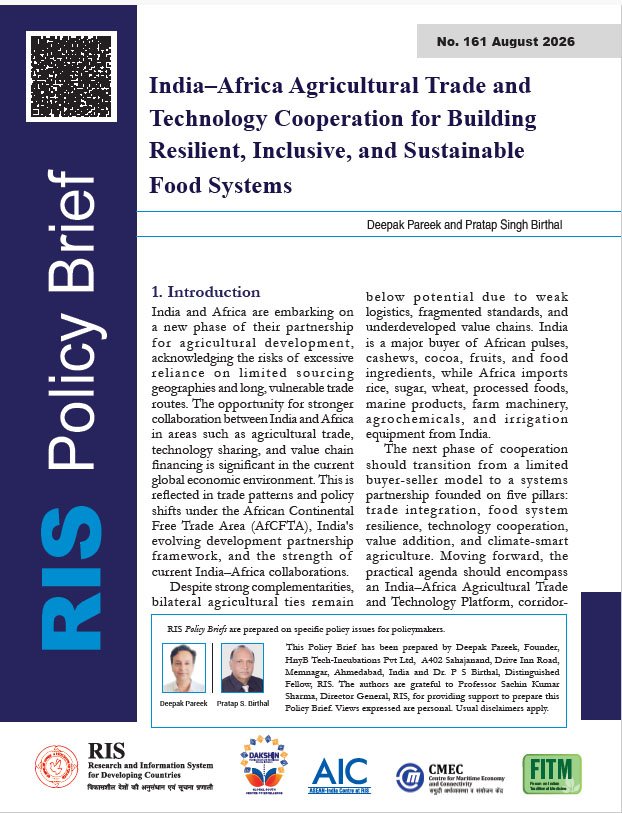
RIS No. 161 August 2026 India–Africa Agricultural Trade and Technology Cooperation for Building Resilient, Inclusive, and Sustainable Food Systems Policy Brief Deepak Pareek and Pratap Singh Birthal 1. Introduction India and Africa are embarking on a new phase of their partnership for agricultural development, acknowledging the risks of excessive reliance on limited sourcing geographies and long, vulnerable trade routes. The opportunity for stronger collaboration between India and Africa in areas such as agricultural trade, technology sharing, and value chain financing is significant in the current global economic environment. This is reflected in trade patterns and policy shifts under the African Continental Free Trade Area (AfCFTA), India's evolving development partnership framework, and the strength of current India–Africa collaborations. Despite strong complementarities, bilateral agricultural ties remain below potential due to weak logistics, fragmented standards, and underdeveloped value chains. India is a major buyer of African pulses, cashews, cocoa, fruits, and food ingredients, while Africa imports rice, sugar, wheat, processed foods, marine products, farm machinery, agrochemicals, and irrigation equipment from India. The next phase of cooperation should transition from a limited buyer-seller model to a systems partnership founded on five pillars: trade integration, food system resilience, technology cooperation, value addition, and climate-smart agriculture. Moving forward, the practical agenda should encompass an India–Africa Agricultural Trade and Technology Platform, corridor- FITM Forum on Indian Traditional Medicine Deepak Pareek Pratap S. Birthal RIS Policy Briefs are prepared on specific policy issues for policymakers. This Policy Brief has been prepared by Deepak Pareek, Founder, HnyB Tech-Incubations Pvt Ltd, A402 Sahajanand, Drive Inn Road, Memnagar, Ahmedabad, India and Dr. P S Birthal, Distinguished Fellow, RIS. The authors are grateful to Professor Sachin Kumar Sharma, Director General, RIS, for providing support to prepare this Policy Brief. Views expressed are personal. Usual disclaimers apply.
Source page 2
2 RIS Policy Brief # 161 based agro-logistics investments, harmonized standards, digital infrastructure for agriculture, blended finance for agro-processing, and joint food security architecture, including cereals, pulses, oilseeds, and agricultural inputs. If executed effectively, this partnership can become a cornerstone of the development framework of the Global South. 2. India – Africa Relations: Antecedents India and Africa share long-standing historical ties rooted in maritime trade, anti-colonial solidarity, people- to-people links, and a common commitment to equitable development. Over the past two decades, these ties have gained a stronger institutional base through the India–Africa Forum Summits. Agriculture has become a key component of this partnership as it lies at the intersection of livelihoods, food security, industrial growth, political stability, and trade. The strategic importance of such partnerships has become increasingly pronounced in recent years. The COVID-19 pandemic, the conflict between Russia and Ukraine, disruptions in the Red Sea, and tensions in West Asia have highlighted the vulnerabilities of the global food system. For Africa, the challenge is dual: a large agrarian population and abundant agro-ecological potential coexist with food import dependence, low productivity, post-harvest losses, weak processing capacity, and insufficient market integration. For India, the rising demand for edible oils, pulses, food ingredients, nuts, and fertilizers supports diversifying sourcing and investing in stable supply partnerships. India also excels in smallholder-oriented technologies, digital public infrastructure, low- cost mechanization, seed systems, extension, irrigation, and agro- processing, which match Africa's development needs. The AfCFTA ’s implementation introduced a new dimension. A more integrated African market can improve scale, support regional value chains, and create India– Africa commercial partnerships in agriculture and food processing, encompassing seed systems, irrigation management, logistics, and value addition. The rise of the Global South as a political and economic force provides a fillip to this partnership between India and Africa. During its G20 presidency, India emphasized addressing the food, fertilizer, fuel, and financial constraints faced by the developing world. The inclusion of the African Union as a member of the G20 was a milestone. Agricultural partnerships between India and Africa can capitalize on this progress. The Indian diaspora in Africa, which now numbers over three million, remains a largely untapped strategic resource. Since the 1860s, waves of migration have occurred, beginning with indentured laborers, followed by merchant settlers in the late 19th and early 20th centuries, particularly Gujarati and Kutchi traders, and later, professionals after the 1970s. These groups have developed lasting commercial and social networks and firmly established themselves in manufacturing, agro-industry, logistics, retail, pharmaceuticals, and FMCG. In terms of policy
Source page 3
3 RIS Policy Brief # 161 engagement, the diaspora provides valuable market insights, fosters trust, and offers language proficiency and local investment channels, all of which should be strategically leveraged through formal agreements for value chain development. Africa possesses significant untapped agricultural potential: approximately two-thirds of the world's uncultivated arable land, 1 amounting to 874 million hectares,2 and around 300 million hectares suitable for rainfed agriculture. However, the primary challenge lies in productivity. By closing yield gaps using better seeds, irrigation, mechanization, and market linkages, output in many regions can be significantly increased. It is pertinent to say that India and Africa must shape an agricultural partnership that goes beyond transactional trade and supports resilient, inclusive, and sustainable food systems. 3. India–Africa Agricultural Trade Landscape Trade Profile and Recent Trends India–Africa merchandize trade in goods has expanded significantly (Table 1). Agricultural trade is a meaningful but underleveraged component of it. India's significant agricultural import partnerships in Africa include Mozambique, Tanzania, Malawi, South Africa, Côte d’Ivoire, Ghana, Nigeria, Egypt, Kenya, Senegal, and Ethiopia. India procures large quantities of pulses from Mozambique and Malawi through government- backed agreements. Countries in East and Southern Africa are especially important for supplying pulses, oilseeds, and nuts. India exports to numerous African countries, including South Africa, Nigeria, Egypt, Kenya, Tanzania, Mozambique, Uganda, Ethiopia, Ghana and Senegal. However, trade 1 Feed Africa Strategy, Af- rican Development Bank - https://www.afdb.org/ fileadmin/uploads/afdb/ Documents/Generic-Doc- uments/Brochure_Feed_ Africa_-En.pdf 2 Africa’s Untapped Agricul- tural Land: A Strategic As- set for Global Food Secu- rity - https://furtherafrica. com/2025/04/02/africas- untapped-agricultural-land- a-strategic-asset-for-global- food-security/ 3 The ET - https://eco- nomictimes.indiatimes. com/news/economy/ foreign-trade/india-af- rica-trade-crossed-usd- 100-billion-in-2024-25- kirti-vardhan-singh/ articleshow/123543923. cms, Ministry of External Affairs, Government of India; IANS Live, Busi- ness Standard, Ministry of Commerce https://trades- tat.commerce.gov.in/eidb/ country_wise_ttrade Table 1: India–Africa Overall Bilateral Trade (US$ billion)3 Year India’s Exports India’s Imports Total Bilateral Trade Remarks 2019–20 28.0 28.0 56.0 Balanced trade structure before pandemic disruption 2020–21 27.0 28.0 55.0 Decline linked to COVID-19 disruptions in trade and logistics 2021–22 43.5 46.0 89.5 Sharp post-pandemic rebound in bilateral trade 2022–23 43 42 85.0 Moderation following correction in global commodity prices 2023–24 49 48 97.0 Trade approached the US$ 100 billion mark 2024–25 53 50 103 Trade crossed US$ 100 billion officially
Source page 4
4 RIS Policy Brief # 161 dynamics vary depending on the product type and governing policy framework. Commodity Concentration and Untapped Scope India's import portfolio is concentrated, with a significant reliance on Southeast Asia for edible oils. Although Africa has significant potential for producing oilseeds, pulses, horticultural products, and specialty crops, its role in India's strategic sourcing remains limited. Similarly, African countries continue to import food products and agricultural inputs from India, but they lack long-term partnerships with Indian suppliers. This concentration poses risks. A narrow commodity base does not support resilient trade. A more diversified basket could include soybeans, groundnuts, sesame, pigeon pea, chickpea, lentils, macadamia, avocado, banana, mango, grapes, spices, tea, coffee, animal feed, and processed foods. There is also room for trading seed materials, fertilizers, bio-inputs, and agricultural services. Tariff and Non-Tariff Constraints Trade barriers are significant. Many African countries apply variable tariffs on processed foods and commodities such as rice, wheat, and sugar. While India maintains low or no tariffs for Least Developed Countries (LDCs), it imposes significant controls on sensitive agricultural commodities. Non-tariff barriers are often more important. These include slow customs procedures, weak testing capacity, differing labeling rules, unpredictable import permits, and fragmented standards. Sanitary and phytosanitary (SPS) measures can create genuine safety concerns and hidden trade costs. Limited laboratory accreditation, insufficient pest risk analysis capacity, and gaps in traceability systems affect the export of fresh produce, livestock products, seeds, and processed foods. AfCFTA Implications The AfCFTA aims to create a continent-wide market, potentially transforming the India–Africa Table 2: India’s Top 5 Trading Partners in Africa (US$ billion) Country 2019-20 2020-21 2021-22 2022-23 2023-24 Key Trade Features South Africa 10.0 8.0 14.0 13.0 14.0 Minerals, chemicals, machinery, pharmaceuticals Nigeria 14.0 10.0 15.0 12.0 11.0 Crude oil imports; Indian exports include pharmaceuticals and machinery Tanzania 4.0 3.5 5.5 6.48 7.9 Fast-rising partner; pulses, cashew, rice, pharma, machinery Egypt 3.5 3.0 7.26 4.1 5.0 Petroleum, fertilizers, cotton, chemicals, machinery, pharma Angola 5.0 4.0 6.0 5.0 4.5 Trade dominated by crude oil imports
Source page 5
5 RIS Policy Brief # 161 4 FAOSTAT Agricultural Production Statistics 2010– 2023, released December 2024; World Bank cereal production data; OECD- FAO Agricultural Outlook. agricultural partnership. For India, it offers not just national markets but a regional platform. For African partners, the AfCFTA provides a path to scale, regional sourcing, and value retention before export. India should align its agricultural trade strategies with this shift. Engagement with Africa must be region-aware, linked to trade corridors, and designed for continental integration rather than isolated bilateral deals. 4. Global Food Security and Emerging Geopolitical Dynamics Food systems are central to economic diplomacy and strategic statecraft due to three major disruptions. First, the Covid-19 pandemic disrupted labor, shipping, storage, and borders. Second, geopolitical events, such as the Russia-Ukraine conflict and West Asia tensions, unsettled grain, oil, and fertilizer markets, affecting Table 3: Africa’s Agricultural Production, 2019–2023: Cereals, Pulses, and Oilseeds (million tons)4 2019 2020 2021 2022 2023 Key Notes Cereals 210.0 213.0 215.0 208.0 212.0 Dip in 2022 linked to Horn of Africa drought and fertilizer shortages; major producers include Ethiopia, Nigeria, and Egypt Pulses 20.5 21.0 21.5 22.0 22.5 Steady upward trend; key producers include Tanzania, Ethiopia, Nigeria, Mozambique, and Malawi Oilseeds 25.5 26.0 26.5 27.0 27.5 Strong potential in groundnut, sesame, and sunflower; major processing gap persists across the continent wheat, maize, sunflower oil, potash, ammonia, and gas-related fertilizers. Finally, climate-related extreme weather increases output volatility across regions. The impact of these shocks has been profound in developing economies. The FAO Food Price Index hit unprecedented highs in 2022 before stabilizing, yet volatility remains high and is rising. Fertilizer and energy prices have behaved similarly. Increased freight costs, insurance rates, and shipping disruptions further intensify price pressures. This environment creates both risks and opportunities for India and Africa. Many African economies are net food importers and are highly exposed to global price swings. India has achieved self-sufficiency in major staples but remains deficient in edible oils, certain pulses, and fertilizers. Both share a strategic interest in diversified sourcing, regional value addition, and buffer-building across key commodities. The second geopolitical shift is the rise of friendshoring and trusted supply chains. Developed countries
Source page 6
6 RIS Policy Brief # 161 are rethinking their dependencies on semiconductors, energy, and critical minerals. A parallel logic now applies to the food systems. Countries seek partners offering reliability, political alignment, and developmental reciprocity. India and Africa can frame their engagement not as an exclusive bloc but as a practical network of reliable partners within the Global South. The third shift is the growing overlap between climate and food diplomacy. Climate finance, carbon markets, resilient seeds, water management, and adaptation technologies shape agricultural competitiveness. Countries that combine productivity with sustainability will hold stronger positions in future trade. India– Africa cooperation in climate-smart agriculture can strategically prepare countries for future food security. 5. Opportunities for Greater Engagement Pulses and oilseeds are a clear area of collaboration. India is the largest consumer and often a major importer, especially during domestic shortages. African countries such as Mozambique, Tanzania, Malawi, Kenya, Sudan, and Ethiopia can export pigeon peas, chickpeas, lentils, and other pulses. Government-backed procurement in East Africa shows that structured partnerships can stabilize trade and incentivize production. The next step is to move from spot purchases to long-term production contracts, seed support, extension, storage, and local processing. India imports large quantities of edible oil and oilseed products. Several African countries have scope in soybean, groundnut, sesame, and sunflower-linked processing. India can support seed systems, mechanization, crushing capacity, and processing investments to build mutually beneficial supply chains. Africa’s diverse agro-climatic conditions create potential for fresh fruits, vegetables, floriculture, nuts, spices, and specialty products. Kenya, Ethiopia, South Africa, Morocco, Egypt, Côte d’Ivoire, Ghana, and Tanzania have established or developing strengths in export horticulture. Indian firms can engage in seed development, greenhouse systems, post-harvest management, dehydration, spice processing, and retail-linked supply chains. A unique opportunity exists in the cashew industry, where African countries produce raw nuts, but most of the value addition occurs elsewhere. With its experience in cashew processing, India can help develop processing infrastructure in Africa. Many African coastal and inland economies aim to expand aquaculture, cold chains, fish feed production, hatcheries, and export-oriented marine value chains. India’s expertise in fresh and brackish water shrimp aquaculture, feed systems, hatchery management, quality certification, and seafood processing can be adapted to Africa. Several African countries are experiencing significant milk shortages. India's cooperative dairy model, along with its expertise in animal health, fodder development, and cost-effective processing technologies, offers valuable insights. Additionally, opportunities for trade and investment arise in areas such as feed ingredients, veterinary services, vaccine logistics and breeding support.
Source page 7
7 RIS Policy Brief # 161 Regional and Corridor-Based Opportunity The commercial logic is compelling when opportunities are considered on a regional basis. East Africa has potential in the fields of pulses, horticulture, and dairy. West Africa is notable for its cashew, cocoa, and rice production. Southern Africa offers prospects for commercial agriculture, logistics hubs, and retail supply chains. North Africa excels in fertilizer and food manufacturing. Under the AfCFTA, these regional strengths can align with Indian demand, technology, and investment. 6. Technology and Digital Cooperation Agricultural transformation in India and Africa will increasingly rely on digital systems and low-cost technologies tailored to the needs of small farms. India has developed scalable public digital systems for payments, identity-linked service delivery, remote advisory services, and agricultural databases. The Digital Public Agriculture Infrastructure (DPAI) is particularly relevant for Africa, where data systems are fragmented and weak. The first area of cooperation is farmer-centric digital platforms. India’s experience with digital platforms for soil health, weather information, direct benefit transfers, crop insurance interfaces, and market price dissemination can inform modular systems that African countries can adapt to local governance needs. The second area is AI-enabled advisory and remote-sensing. Satellite imagery, drones, geospatial analytics, and machine learning support crop monitoring, irrigation scheduling, yield estimation, pest surveillance, and drought warnings. India’s public institutions and agri-tech firms have growing capabilities in these fields. Joint pilots in African agroecologies can help build decision-support tools for governments, insurers, banks, and farmer organizations. The third area is precision agriculture and low-cost mechanization. African agricultural systems often require technologies for small-scale plots. Indian manufacturers produce mini tractors, planters, threshers, irrigation pumps, solar pumps, micro-irrigation systems, and post-harvest equipment, among others. Technology transfer should extend beyond trade to include local assembly, technician training, spare-part networks, and financing models. The fourth area is fintech for agri-finance. Access to formal credit remains weak across many African rural economies. Digital lending tools, warehouse receipt systems, mobile payments, and supply chain financing can reduce risk and improve inclusion. When adapted carefully, Indian fintech and agri-finance models can support crop loans, equipment leasing, invoice financing, and embedded finance for inputs and market access. The fifth area is traceability and standards compliance. As global food trade becomes more compliance- driven, exporters require digital systems for tracking, residue monitoring, certification, and sustainability claims. Practical digital traceability tools linked to QR-based batch records, testing systems, and warehouse tracking can improve the transparency of the supply chain.
Source page 8
8 RIS Policy Brief # 161 The policy priority is to position technology cooperation as a public- good partnership, not only as a commercial export channel. Joint innovation hubs, pilot farms, startup exchanges, and public-private demonstration platforms can help create such models. 7. Value Chains, Logistics, and Trade Facilitation The trade potential depends on reliable value chains. In many India– Africa agricultural corridors, the highest costs occur post-production and pre-sale. Post-harvest losses are high in perishable sectors due to poor aggregation, weak cold storage, inadequate packhouses, unreliable electricity, limited refrigerated transport, and congested ports. Bridging these gaps requires a corridor- based approach. Agro-Processing and Local Value Addition A central weakness in current India–Africa agricultural trade is the dominance of raw or semi- processed commodity flow. Greater value can be retained in Africa through agro-processing, whereas Indian firms gain more stable and scalable supply relationships. Priority sectors include pulse cleaning and splitting, oilseed crushing, cashew processing, fruit pulping, spice grinding, dairy processing, fish processing, feed milling, grain storage, and milling. Cold Chains, Warehousing, and Food Hubs The trade in fruits, vegetables, dairy, meat, and seafood relies on cold chains. India and African partners can develop integrated cold-chain projects covering packhouses, precooling, refrigerated transport, ripening systems, and export logistics. Scientific warehousing and silo systems are crucial for staples and pulses. Warehouse receipt financing can support trade while reducing distress sales. Regional food hubs under the AfCFTA deserve attention. Strategically located processing and logistics hubs near ports, rail junctions or high-production zones can serve multiple countries. These hubs can combine testing laboratories, customs facilitation, warehousing, grading, and export certification services. India–Africa Agri-Logistics Corridors Trade is often hampered by weak maritime connectivity, irregular shipping schedules, high insurance costs and inefficient transshipment routes. Dedicated India–Africa agri-logistics corridors can reduce transaction costs. These may involve priority shipping arrangements between western Indian ports and East African ports or between Indian ports and West African gateways for processed foods and agri-inputs. Port community systems, digital documentation, and faster customs clearance would strengthen corridor performance. Trade Facilitation and Standards Cooperation Trade facilitation should include more than just customs simplification. It must cover mutual recognition pathways for testing, standardized phytosanitary certificates, electronic certification systems, pest risk assessments, and laboratory capacity building. Fast-track arrangements for
Source page 9
9 RIS Policy Brief # 161 trusted exporters and importers of selected commodities could reduce delays. A useful model would be commodity-specific facilitation cells for pulses, edible oils and oilseeds, and food ingredients. Without logistics modernization and facilitation reforms, higher trade ambitions will remain constrained by ground-level inefficiencies. 8. Climate-Smart Agriculture and Sustainability Climate stress is no longer a future risk. It has already reshaped planting decisions, productivity patterns, and trade reliability. India and Africa are among the most climate-exposed regions; therefore, their agricultural partnership must be built on adaptation, resilience, and resource efficiency. The first area is water-smart agriculture. Water scarcity, groundwater stress, and rainfall variability call for the wider adoption of drip irrigation, sprinklers, micro-irrigation, rainwater harvesting, and water budgeting. India has practical experience in scaling micro-irrigation and low-cost water management tools that can be adapted to African dryland and semi-arid systems. The second area is soil health and nutrient management. Many African soils suffer from nutrient depletion and low organic matter, whereas Indian farming faces imbalanced fertilizer use in several regions. Joint work on soil testing, customized fertilizer blends, biofertilizers, composting, micronutrient management, and integrated nutrient systems can improve productivity and reduce the environmental stress. The third area is climate-resilient seeds. Crop varieties that can withstand drought, heat, and floods, as well as those with short growth periods, will become increasingly vital. India's public and private seed sectors can collaborate with African research institutions on varietal adaptation, seed multiplication, and the development of local seed enterprises. The fourth area is regenerative and low-emission agriculture. Reduced tillage, crop rotation, agroforestry, residue management, integrated pest management, and integrated farming systems can enhance the resilience of farming systems. These strategies should be linked to farmers' economic interests, not just environmental messages. The fifth area is the integration of renewable energy into food systems. Solar pumps, solar dryers, decentralized cold rooms, biomass-based energy, and mini-grids can reduce costs and improve energy access in rural areas. Climate-smart cooperation should include risk management tools, such as weather-index insurance, digital advisories, early warning systems, and contingency planning. Sustainability must be viewed as a productivity and risk agenda, not an external compliance burden. 9. Institutional and Financing Frameworks A stronger India–Africa agricultural partnership requires patient capital, institutional continuity, and mechanisms that align public goals with commercial viability. India’s development partnership with Africa includes substantial concessional finance and capacity-building channels. 5 Credit Lines extended by India Exim Bank as on June 30, 2025 - https://www.eximban- kindia.in/sites/default/ files/2025-08/India- Exim-Bank-TAP-Credit- Line-June-2025.pdf
Source page 10
10 RIS Policy Brief # 161 The EXIM Bank of India has extended numerous Lines of Credit across African countries 5 for agriculture, irrigation, rural electrification, sugar plants, and related sectors. These instruments remain important but require sharper alignment with value- chain priorities and implementation capacity. Financing Architecture Three financing channels should anchor future collaborations. First, public and concessional finance can support catalytic infrastructure, such as irrigation systems, testing labs, seed facilities, rural roads linked to production clusters, and agro-logistics hubs. Second, blended finance can crowd in private investments for processing, cold chains, farm mechanization, and digital platforms. Third, commercial finance and equity can scale up mature ventures in agribusiness, retail supply chains, and food manufacturing. Institutions such as the African Development Bank (AfDB), Afreximbank, national development finance institutions, sovereign funds, and Indian financial institutions can co-develop structured vehicles for agriculture financing. Joint credit guarantee mechanisms can reduce the risk premium for cross-border agribusiness investments. Public-Private Partnerships and Joint Ventures Public-private partnerships (PPPs) are effective in areas with a component of public benefit, such as irrigation command zones, infrastructure for last-mile aggregation, cold and dry storage facilities, and testing systems. Joint ventures between Indian firms and African enterprises are especially useful for seed production, agro- processing, machinery assembly, fertilizer production, and digital services. Local ownership and capability transfers are critical for long-term legitimacy. Institutional Platforms The policy architecture also requires stronger coordination. A dedicated India–Africa Agricultural Partnership Mechanism could bring together the ministries of commerce, agriculture, external affairs, standards agencies, development finance institutions, and private sector bodies. Such a mechanism should be linked to IAFS commitments and AfCFTA institutions, where relevant. Capacity building must remain a priority. India’s training programs under ITEC and related initiatives can be expanded to include agricultural regulators, extension officers, laboratory managers, digital agriculture specialists, and agribusiness entrepreneurs. Long- term partnerships among agricultural research institutes and business schools can strengthen knowledge exchanges. Finance alone is insufficient. What matters is moving from announcements to delivery, which requires clear project pipelines, bankable designs, local stakeholder ownership, and outcome monitoring mechanisms. 10. Key Challenges and Risks Despite their strong potential, deeper India–Africa agricultural partnerships may face significant constraints.
Source page 11
11 RIS Policy Brief # 161 First, logistical bottlenecks remain a significant issue. Weak rural roads, port congestion, high inland transport costs, limited reefer networks, and inconsistent shipping connectivity increase delivery times and reduce competitiveness. These issues are acute for perishable and high-value exports. Second, infrastructure deficits constrain productivity and processing capabilities. Many regions face inadequate irrigation, unreliable power, weak storage, poor testing facilities, and limited industrial infrastructure for agroprocessing. Third, regulatory divergence creates uncertainties. Different tariff regimes, import licensing rules, SPS standards, seed regulations, and certification requirements increase compliance costs. In some cases, policy unpredictability matters more than formal tariff rates. Fourth, political and macroeconomic risks remain relevant in some markets. Currency volatility, debt stress, sudden policy changes, conflict, and political uncertainty can all disrupt long-term investments. Fifth, institutional capacity gaps affect the implementation of policies. Many promising bilateral initiatives underperform because of limited project preparation, weak extension systems, a shortage of quality inspectors, or poor coordination between trade and agriculture authorities. Sixth, climate vulnerability is increasing. Droughts, floods, pests, heat waves, and water stress can derail output projections and create volatility in supply chains built around a few regions or commodities. Finally, there is a strategic risk of repeating extractive and narrow trade models. If engagement focuses only on raw commodity sourcing without local value addition, skills transfer, and resilience building, it may fail to generate broad political support. 11. Recommendations A deeper India–Africa agricultural compact should be operational, investment-ready, and linked to the resilience of food systems. The following recommendations offer a structured approach. Establish an India–Africa Agricultural Trade and Technology Platform A formal intergovernmental platform should be created to bring together commerce, agriculture, external affairs, standards agencies, development finance institutions, and private sector representatives. Its mandate should include trade diagnostics, project pipelines, standards cooperation and annual ministerial reviews. Develop a strategic commodity partnership framework Move from ad hoc trade to medium- term sourcing arrangements tied to seed support, extension, aggregation, warehousing, and local processing. The focus should initially be on pulses from East and Southern Africa, oilseeds from multiple sub-regions, and high- value horticulture with strong market demand. Align India’s Africa trade strategy with AfCFTA and regional value chains Design engagement around regional hubs and corridors rather than only bilateral transactions. Support investments that can serve
Source page 12
12 RIS Policy Brief # 161 multiple African markets under AfCFTA rules of origin, especially in agro-processing, warehousing and food distribution. Create India–Africa agro- processing and logistics corridors Identify priority corridors linking production zones, processing centers, and ports. Blended finance should be provided for cold chains, scientific storage, reefer transport, testing facilities, and digital customs systems. Start with high-potential routes in East Africa and West Africa. Launch a joint SPS, standards, and traceability initiative Support laboratory accreditation, electronic phytosanitary certification, residue testing, pest surveillance, and exporter training. Create fast-track protocols for selected trusted commodities and firms. This would reduce shipment rejections. Scale digital public infrastructure cooperation for agriculture Modular digital systems should be built for farmer databases, crop advisories, weather services, credit scoring, market linkages, and insurance interfaces. Joint pilots should be encouraged in partnership with African governments, research institutions, and startups. Data governance and local ownership should be built into project design. Promote local manufacturing and assembly of smallholder- oriented farm technologies Indian firms should be encouraged to set up assembly and servicing hubs in Africa for irrigation systems, pumps, mini tractors, planters, threshers, dryers, and food processing equipment. Link this with technician skilling, spare-parts ecosystems, and lease- based finance models. Expand blended finance and risk-sharing instruments for agribusiness investment EXIM Bank, AfDB, Afreximbank, and their partner DFIs should create co-financing windows, partial credit guarantees, and foreign exchange risk mitigation instruments for agro-processing, storage, digital agriculture, and farm services. Smaller firms need easier access to these instruments. Strengthen institutional capacity and knowledge partnerships Training for regulators, extension workers, quarantine officials, digital agriculture specialists, and agribusiness managers should be expanded. Foster long-term collaboration among Indian agricultural research institutions, African Centers of Excellence, and private incubators. Build a joint food security architecture for strategic commodities Explore mechanisms for coordinated planning in pulses, edible oil supply chains, fertilizers, and emergency food shipments during crisis years. This could include pre-negotiated supply arrangements, stock visibility tools, and crisis consultation protocols, among others. These recommendations should be implemented in phases. Quick wins lie in the areas of pulses, digital
Source page 13
13 RIS Policy Brief # 161 advisory platforms, and machinery assembly. Medium-term gains lie in the processing corridors, food hubs, and blended finance vehicles. Long- term success depends on whether the partnership is embedded in national food security and industrial strategies on both sides. 12. Conclusion India–Africa agricultural cooperation is at a strategic juncture. The old model of limited commodity trade is inadequate in changing global dynamics. A broader partnership based on mutual trust, shared goals, and developmental reciprocity is needed. India has a demand scale, technological capability, institutional experience in smallholder agriculture, and a track record of development partnerships. Africa brings land and agro-ecological diversity, youthful labor forces, growing regional markets, and the transformative promise of the AfCFTA. When these strengths are connected through the right infrastructure, finance, standards systems, and policy coordination, the result can be far greater than incremental trade growth. The significance of this agenda extends beyond bilateral relations. A stronger India–Africa agricultural compact can shape a more balanced and resilient architecture for Global South food systems. It can diversify sourcing, reduce vulnerability to external shocks, improve farmer income, expand processing and employment, and strengthen food access in both regions. It also offers a practical model of South-South cooperation grounded not in rhetoric, but in production, technology, institutions, and trust. PB#160-2026 India–Japan Science, Technology and Innovation Cooperation: From Scientific Collaboration to Strategic Technology Partnership by Sanjeev K. Varshney, Amit Kumar, Sneha Sinha and Alaknanda Mishra PB#159-2026 From Pharmacy to Partner: Upgrading India-Africa Health Cooperation to a One Health and AMR Compact at India Africa Forum Summit (IAFS) IV by Monika Kochar PB#158-2026 Digital Innovations for Strengthening Health Security in the Global South by Monika Kochar PB#157-2026 People-to-People Ties in the Bay of Bengal Region: Investing in Mobility, Sub- national and Research Engagements by Constantino Xavier PB#156-2026 Energy Security Based on Renewable Sources in Africa: The Role of India-Africa Partnership by Anshuman Gupta PB#155-2026 Promoting Regional Cooperation through BIMSTEC by Uttam Kumar Shahi PB#154-2026 India-Africa Cooperation on Trade and Transfer of Technology by Atul Kaushik and Alisha Goswami PB#153-2026 WTO Saga: Agriculture Export Restrictions in Times of Crisis by Sachin Kumar Sharma, Paavni Mathur, Talha Akbar Kamal and Teesta Lahiri PB#152-2026 India’ s AI-Enabled Bharat VISTAAR Platform: Lessons for Bridging Agricultural Information Gap in Sub-Saharan Africa by Pratap S Birthal, Sachin Kumar Sharma and Tanya Singh RIS Policy Briefs
Source page 14
Core IV-B, Fourth Floor, India Habitat Centre, Lodhi Road, New Delhi-110 003, India., Tel. 91-11-24682177-80, Email: [email protected], Website: www.ris.org.in — Policy research to shape the international development agenda — AIC at RIS has been working to strengthen India’s strategic partnership with ASEAN in its realisation of the ASEAN Community. AIC at RIS undertakes research, policy advocacy and regular networking activities with relevant organisations and think-tanks in India and ASEAN countries, with the aim of providing policy inputs, up-to-date information, data resources and sustained interaction, for strengthening ASEAN-India Comprehensive Strategic Partnership. The word “DAKSHIN” ( nf{k.k½ is of Sanskrit origin, meaning “South.” The Hon’ble Prime Minister of India, Shri Narendra Modi, inaugurated DAKSHIN – Global South Centre of Excellence in November 2023. The initiative was inspired by the deliberations of Global South leaders during the Voice of the Global South Summits. DAKSHIN stands for Development and Knowledge Sharing Initiative. Hosted at the RIS, DAKSHIN has established linkages with leading think tanks and universities across the Global South and is building a dynamic network of scholars working on Global South issues. FITM is a joint initiative by the Ministry of Ayush and RIS. It has been established with the objective of undertaking policy research on economy, intellectual property rights (IPRs) trade, sustainability and international cooperation in traditional medicines. FITM provides analytical support to the Ministry of Ayush on policy and strategy responses on emerging national and global developments. FITM Forum on Indian Traditional Medicine FISD aims to harness the full potential and synergy between science and technology, diplomacy, foreign policy and development cooperation in order to meet India’s development and security needs. It is also engaged in strengthening India’s engagement with the international system and on key global issues involving science and technology. Forum for Indian Science DiplomacyFISD BEF aims to serve as a dedicated platform for fostering dialogue on promoting the concept in the Indian Ocean and other regions. The forum focuses on conducting studies on the potential, prospects and challenges of blue economy; providing regular inputs to practitioners in the government and the private sectors; and promoting advocacy for its smooth adoption in national economic policies. BLUE ECONOMY FORUM BEF As part of its work programme, RIS has been deeply involved in strengthening economic integration in the South Asia region. In this context, the role of the South Asia Centre for Policy Studies (SACEPS) is very important. SACEPS is a network organisation engaged in addressing regional issues of common concerns in South Asia. Knowledge generated endogenously among the Southern partners can help in consolidation of stronger common issues at different global policy fora. The purpose of NeST is to provide a global platform for Southern Think-Tanks for collaboratively generating, systematising, consolidating and sharing knowledge on South South Cooperation approaches for international development. FIDC, has been engaged in exploring nuances of India’s development cooperation programme, keeping in view the wider perspective of South-South Cooperation in the backdrop of international development cooperation scenario. It is a tripartite initiative of the Development Partnership Administration (DPA) of the Ministry of External Affairs, Government of India, academia and civil society organisations. www.facebook.com/risindia @RIS_NewDelhi www.youtube.com/RISNewDelhi Follow us on: RIS specialises in issues related to international economic development, trade, investment and technology. It is envisioned as a forum for fostering effective policy dialogue and capacity-building among developing countries on global and regional economic issues. The focus of the work programme of RIS is to promote South-South Cooperation and collaborate with developing countries in multilateral negotiations in various forums. Through its following centres/forums, RIS promotes policy dialogue and coherence on regional and international economic issues. CMEC has been established at RIS under the aegis of the Ministry of Ports, Shipping and Waterways (MoPS&W), Government of India, and in collaboration with the Indian Ports Association (IPA). It has been mandated to act as an advisory/technological arm of MoPSW to provide the analytical support on policies and their implementation.