Source page 1
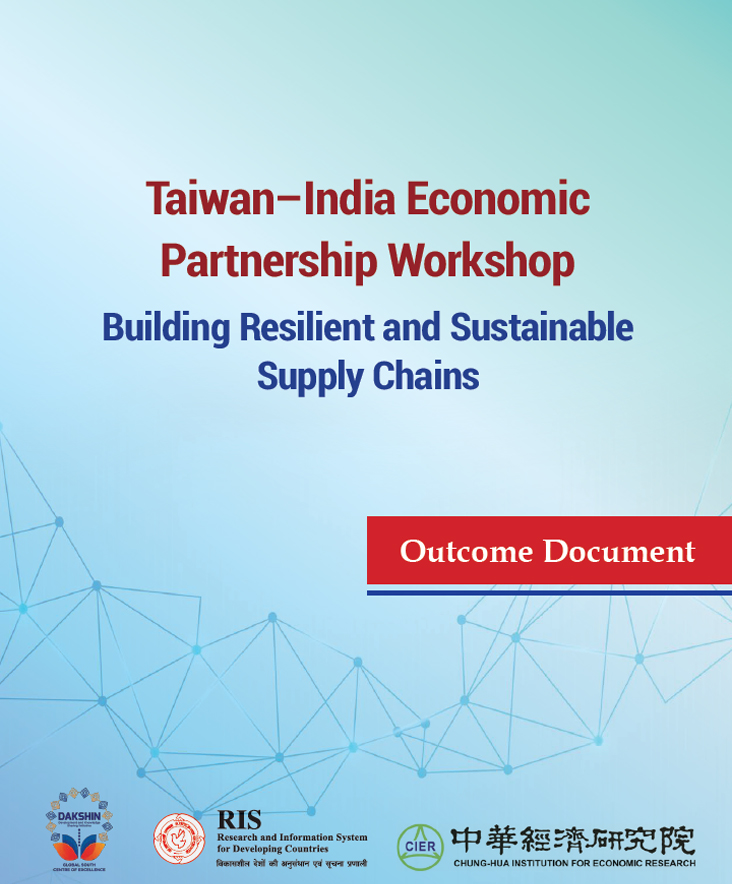
Taiwan–India Economic Partnership Workshop Building Resilient and Sustainable Supply Chains Outcome Document
Source page 2
Source page 3
Taiwan–India Economic Partnership Workshop on Building Resilient and Sustainable Supply Chains 25 May 2026 New Delhi Outcome Document
Source page 4
Zone IV B, 4th Floor, India Habitat Centre Lodhi Road, New Delhi 110 003, India Tel.: +91-11-24682177-80; Fax: +91-11-24682173-74 E-mail: [email protected] Website: www.ris.org.in; http://aic.ris.org.in Published by: © RIS, 2026 Acknowledgements This Outcome Document is prepared by Dr. Adrija Ganguly, Consultant, RIS under the guidance of Prof. Prabir De. Dr. Srinivas Rao, Fellow, RIS coordinated the workshop and Mr. Vassu Agarwal and Mr. Avinash were the rapporteurs. Publication of the Outcome Document is coordinated by RIS Publication Team comprising Mr. Sanjay Singh, Mr Sachin Singhal, Mr. Sanjeev Karma and Ms. Karanpreet Kaur.
Source page 5
Foreword by Director General, RIS..................................... ............................................................... vii Summary............................................... ...............................................................................................1 Key Takeaways.......................................................................... ........................................................25 Agenda……………………………....................................................................................................29 Concept Note............................................................................ .........................................................31 Profile of Speakers.............................................................................................................................33 Glimpses of the Workshop ..............................................................................................................39 CONTENTS
Source page 6
Source page 7
VII Professor Sachin Kumar Sharma Director General, RIS The contemporary global economic landscape is being reshaped by multiple challenges, including geopolitical uncertainties, technological disruptions, climate-related risks, and the lingering effects of the COVID-19 pandemic. These developments have highlighted the importance of resilient, diversified, and trusted supply chains. The changing global landscape has fostered economic, trade, digital and technological engagements which laid foundation for India-Taiwan economic cooperation. In this context, India and Taiwan possess significant opportunities to strengthen cooperation by leveraging their complementary strengths in manufacturing, semiconductors, information and communication technologies, innovation ecosystems, digital transformation, and human resource development. The India–Taiwan economic partnership has evolved considerably over the years, driven by expanding trade and investment linkages and supported by a robust framework of institutional cooperation. Rising bilateral trade and in terms of value as well as Taiwan happened to be the promising export destinations for Indian minerals, petrochemical products and agri-based products. Similarly, Taiwanese import for India includes electronics and electrical components. Bilateral initiatives covering taxation, customs procedures, agricultural cooperation, industrial promotion, intellectual property protection, labour mobility, and trade facilitation have contributed to deepening economic relations I am pleased to note that RIS has come out with a publication titled “Taiwan–India Economic Partnership Workshop on Building Resilient and Sustainable Supply Chains”. This knowledge material of RIS is written in context of expanding Taiwan-India relationship in terms of semiconductor venture and other areas of technological cooperation. This report showcases the evolving areas of India-Taiwan collaboration that can be fostered to support the complementarities as well as compatibilities. It also offers actionable insights for policymakers, industry stakeholders, and researchers illustrating the areas India can navigate the challenges, harnessing opportunities and form a sustainable bilateral relation. I take this opportunity to thank RIS team led by Prof. Prabir De for coming up with this timely report. Also, I extend my appreciation to publication team for publishing this report. I am hopeful that the report will act as a valuable reference for policy makers, academics and practitioners. Sachin Kumar Sharma FOREWORD
Source page 8
Source page 9
Inaugural Session Professor Sachin Kumar Sharma Director General, RIS Professor Sachin Kumar Sharma, Director General of RIS, opened the workshop by extending his heartfelt gratitude to Professor Prabir De of RIS for convening this important closed-door dialogue. He warmly welcomed all participants and expressed appreciation for their presence, noting that the strong turnout at such a selective event reflected the growing commitment to strengthening India–Taiwan relations and underscored the significance of the discussions ahead. Prof. Sharma conveyed his thanks to the distinguished guests, panellists, participants, and collaborating institutions for their support. He particularly acknowledged the contributions of the co-organizers and partner institutions, RIS and CIER, for jointly convening this timely workshop. He also highlighted his longstanding professional association with several participants, emphasizing the value of sustained collaboration and dialogue in advancing shared objectives. Reflecting on the rationale behind the workshop, Prof. Sharma observed that the contemporary global environment is marked by geopolitical tensions, supply chain disruptions, and intensifying technological competition. In this context, he stressed the growing importance of international cooperation and partnerships to address emerging global challenges. He noted that India and Taiwan possess highly complementary strengths—India’s scale, skilled workforce, and market potential, alongside Taiwan’s leadership in technology, innovation, and advanced manufacturing—creating significant opportunities for mutually beneficial cooperation. SUMMARY 1
Source page 10
Prof. Sharma highlighted the remarkable growth in bilateral trade, which has expanded from approximately US$ 2 billion in 2006 to US$ 13 billion in 2025. He emphasized that this expansion reflects the steady deepening of economic engagement and demonstrates the substantial untapped potential that remains to be harnessed. He further pointed to several notable developments that illustrate the growing momentum in bilateral cooperation. Among them, he referred to India’s first commercial semiconductor fabrication project, a joint venture between Powerchip Semiconductor Manufacturing Corporation (PSMC) of Taiwan and Tata Electronics, as a milestone in the partnership. He also noted the establishment of an India office by Taiwan Semiconductor Manufacturing Company (TSMC), as well as the expanding presence of major Taiwanese firms such as Foxconn and MediaTek in India. These initiatives, he stated, demonstrate the increasing depth and diversity of India–Taiwan economic engagement and the confidence of Taiwanese industry in India’s future. In conclusion, Prof. Sharma once again thanked all participants for their presence and contributions. He expressed confidence that the workshop would generate insightful discussions and practical recommendations for advancing India–Taiwan relations and strengthening the bilateral partnership in the years ahead. Opening Remarks Dr. Mumin Chen Representative TECC New Delhi, India Against the backdrop of expanding Taiwan–India bilateral relations, Dr. Mumin Chen opened his remarks by warm greetings to the distinguished participants, including representatives from RIS and Taiwan. He expressed his appreciation to RIS for organizing the workshop and acknowledged the considerable effort invested by both sides in bringing this important event to fruition. Dr. Chen began by situating Taiwan’s economic profile in the global context. With a population of approximately 23 million, Taiwan has achieved a GDP of nearly US$ 900 billion, ranking among the world’s top 20 economies. Its annual exports exceeded US$ 500 billion, underscoring its role as a major trading nation. He emphasized Taiwan’s growing 2
Source page 11
global reputation as a technology powerhouse, noting that nearly 64 per cent of its exports comprise high-tech and machinery products, particularly semiconductors, which form the backbone of global digital supply chains. Turning to India–Taiwan economic relations, Dr. Chen highlighted that bilateral trade had reached approximately US$ 12.5 billion in the previous year, recording an 18 per cent increase over the preceding year. He noted the increasingly technological character of bilateral trade, with mobile phones accounting for a significant share of India’s exports to Taiwan and semiconductor products forming a substantial share of Taiwan’s exports to India. These trends, he remarked, reflect the growing integration of both economies into technology-driven value chains. Dr. Chen further underscored the progress made in attracting Taiwanese investment to India. He observed that around 350 Taiwanese companies are currently operating across diverse sectors in the country, with semiconductor manufacturing emerging as a particularly important area of cooperation. He stressed that technology and semiconductor collaboration are becoming key pillars of India–Taiwan relations, laying the foundation for deeper strategic engagement. Discussing future prospects, Dr. Chen identified potential and timing as the two critical factors influencing investment decisions. Drawing on his visits to India over the past two decades, he remarked on the country’s remarkable economic and infrastructural transformation and emphasized its potential to emerge as a leading global economic and political power. He described the present period as an opportune moment for international investors to engage with India’s growth trajectory. While noting that Taiwanese investment in India had surpassed US$ 5.5 billion and was steadily increasing, Dr. Chen observed that this figure remained modest compared to Taiwan’s investments in countries such as China and Vietnam, where thousands of Taiwanese companies operate. He, therefore, underscored the substantial untapped potential for expanding Taiwanese investment in India and expressed confidence that deeper economic cooperation would significantly strengthen bilateral engagement in the years ahead. 3
Source page 12
Special Remarks Dr. Kristy Tsun-Tzu Hsu Director, Taiwan ASEAN Studies Centre, Chung-Hua Institution for Economic Research (CIER), Taipei Reflecting on the evolution of Taiwan–India relations over the past decade, Dr. Kristy recalled that in 2012 both governments jointly entrusted the ICRIER with a feasibility study for a Free Trade Agreement (FTA). Although the study, completed in 2014, produced valuable findings and policy recommendations, it did not ultimately lead to formal trade negotiations. Nevertheless, she emphasized that Taiwan–India economic relations have advanced considerably in the past five to six years. Bilateral trade has expanded from approximately US$ 6 billion during the FTA study period to more than US$ 10 billion in recent years, reflecting both growth and diversification. Taiwanese investment in India has also broadened beyond traditional sectors into strategic areas such as ICT, semiconductors, and advanced manufacturing. Dr. Kristy noted that India was not a major destination for Taiwanese overseas investment 10–15 years ago. However, changing global economic dynamics and India’s rapid growth have significantly enhanced its attractiveness. She described the present moment as critical for both sides to reassess and deepen their engagement. She observed that the global economy is experiencing profound uncertainty, marked by rising tariffs, geopolitical tensions, trade protectionism, supply chain disruptions, and ongoing conflicts in regions such as the Middle East and Ukraine. Despite these challenges, several Asian economies—including Taiwan, India, and Southeast Asia—have demonstrated strong resilience. She highlighted that India recorded growth exceeding 7 per cent, while Taiwan registered growth above 8 per cent, one of its strongest performances in the last 15 years. These developments, combined with the ongoing diversification of supply chains away from China, have created strong momentum for enhanced Taiwan–India cooperation. Dr. Kristy informed participants that the Taiwan Electrical and Electronic Manufacturers’ Association (TEEMA), Taiwan’s largest industrial association representing over 3,000 corporate members, was leading a delegation to India during the same week. The delegation was 4
Source page 13
visiting Bengaluru and other cities to explore investment opportunities. She noted that TEEMA’s Chairman, Young Liu, who also heads Foxconn (Hon Hai Technology Group), is keen to bring more Taiwanese companies to India to support Foxconn’s operations in smartphone and electronics manufacturing for both domestic and international markets. She further highlighted that India has been designated by TEEMA as one of its four overseas Taiwan Industrial Park locations. Importantly, India is the only country among the 18 target countries under Taiwan’s New Southbound Policy to host such an initiative. This, she emphasized, reflects the confidence of Taiwanese companies in India’s long-term potential as a major manufacturing hub not only for Asia but also for global markets. In conclusion, Dr. Kristy described the current phase of Taiwan–India relations as a “once-in-a-lifetime” opportunity to strengthen supply chain partnerships and deepen strategic economic cooperation. She expressed optimism about the future trajectory of bilateral engagement and looked forward to further discussions during the workshop. Special Remarks Mr. Ninad S. Deshpande Director General, India-Taipei Association (ITA) Mr. Ninad Deshpande began by expressing his gratitude to RIS for the invitation and conveyed his pleasure at participating in the workshop, albeit virtually. Referring to recent remarks by the Prime Minister of India, he noted that the world is currently facing multiple crises, including the lingering effects of the COVID-19 pandemic, ongoing geopolitical conflicts, and energy insecurity. In this context, he emphasized the growing importance of building resilient supply chains founded on trust, transparency, and reliability. Mr. Deshpande highlighted the role of the India–Taipei Association in strengthening resilient and sustainable supply chains within the broader Indo-Pacific framework. He cited the India–Japan–Taiwan Semiconductor Seminar held in Hsinchu, which brought together over 400 industry participants, as an example of growing trilateral cooperation. He also referred to the forthcoming Taiwan–ASEAN– India Collaboration Forum at Computex in Taipei, which will facilitate 5
Source page 14
engagement among Indian state governments, Taiwanese industries, and ASEAN partners. He argued that the current global environment presents a strong case for deeper partnerships among trusted economies, observing that India and Taiwan are particularly well-positioned to strengthen cooperation owing to their technological capabilities, reliability, and predictable commercial practices. He noted that considerations of resilience and trust have become as important as cost and efficiency in global investment and supply chain decisions. Outlining India’s flagship initiatives, Mr. Deshpande underscored the country’s long-term commitment to industrial and technological development: • India Semiconductor Mission (ISM): Approved 12 projects across six states with investments of approximately US$ 17 billion. • Semiconductor Mission 2.0: Designed with a long-term horizon to sustain growth. • Electronics Component Manufacturing Scheme: Attracted 75 proposals representing more than US$ 6 billion in expected investments. • PM MITRA Scheme: Establishing seven integrated textile parks. • India AI Mission: Strengthening artificial intelligence capabilities through significant investments in computing infrastructure. According to him, these initiatives collectively form a coherent ecosystem that is creating new opportunities for India–Taiwan cooperation. He highlighted several examples of growing collaboration: • The Tata Electronics semiconductor fabrication facility in Dholera, supported by technology from Powerchip Semiconductor Manufacturing Corporation (PSMC). • The Foxconn–HCL semiconductor assembly and testing project. • Investments by Micromax–Fyde Semiconductors. • Delta Electronics’ expansion in Tamil Nadu. Increasing engagement of Taiwanese firms such as Pegatron and Asus in India’s manufacturing and engineering sectors. He also noted contributions by Taiwanese companies in footwear, advanced materials, and steel, reflecting their deeper integration into India’s industrial landscape. Emphasizing the importance of regional cooperation, Mr. Deshpande observed that future supply chains will increasingly be organized through regional architectures rather than purely bilateral arrangements. 6
Source page 15
In this regard, he stressed India’s intention to play an active role in shaping emerging Indo-Pacific economic networks. He further highlighted India’s extensive efforts over the past decade to improve its investment and manufacturing ecosystem through labour reforms, regulatory simplification, logistics improvements, trade facilitation, and the promotion of competitive federalism. Drawing on his experience at the World Trade Organization (WTO), he noted India’s successful implementation of the Trade Facilitation Agreement and its growing credibility as a trade partner. In conclusion, Mr. Deshpande identified two key priorities for the future: • Expanding flagship investment projects in sectors such as semiconductors, electronics, and manufacturing, and • Building the supporting ecosystem Session I: Strengthening Taiwan–India Economic Partnership in a Resilient Indo- Pacific Dr. Rajan Sudesh Ratna Coordinator, DAKSHIN, RIS Dr. Rajan Sudesh Ratna opened his intervention by reflecting on the lessons learned over the past few years regarding the vulnerability of global trade and investment flows to geopolitical conflicts and policy uncertainties. He observed that disruptions in one part of the world have had far-reaching consequences for value chains, supply chains, and connectivity across countries and regions. Referring to the concept of the world as a “global village,” he noted that recent developments have clearly demonstrated the interconnected nature of the global economy and the extent to which international operations can be affected by external shocks. Dr. Ratna emphasized the importance of building resilient and sustainable supply chains in the Indo-Pacific region, underscoring the role of stronger Taiwan–India economic cooperation in achieving this objective. He pointed to the complementarities between the two economies that had already been highlighted during preceding discussions. Specifically, he noted that India exports raw materials to 7
Source page 16
Taiwan, while importing semiconductors and electronic equipment that are critical for India’s industrial and technological development. This exchange, he remarked, illustrates the mutually reinforcing nature of bilateral trade and the potential for deeper collaboration in high-value sectors. Dr. Kristy Tsun-Tzu Hsu Director, CIER, Taipei Dr. Kristy focused her intervention on the changing investment strategies of Taiwanese companies and the growing strategic importance of India in Taiwan’s regional and global economic outlook. At the outset, she acknowledged earlier discussions on the Taiwan–India Free Trade Agreement (FTA) feasibility study conducted more than a decade ago, but clarified that her remarks would concentrate on recent developments and the evolving Taiwanese perspective on India’s role in global supply chains. She explained that Taiwan’s overseas investment patterns have undergone significant transformation over the past decade. During the period of the FTA feasibility study in 2013–14, nearly 60–70 per cent of Taiwan’s outward investment was directed towards China. However, following the onset of trade tensions associated with “Trump 1.0” in 2017–18, Taiwanese investment in China began to decline sharply. Today, Taiwan’s new investments in China account for less than 10 per cent of total outward investment, and in the previous year the share had fallen below 5 per cent. This shift, she explained, reflects broader efforts by Taiwanese companies to diversify beyond China in response to requests from western clients—including American, European, and Japanese firms—seeking to de-risk their supply chains. Taiwanese enterprises have consequently expanded their manufacturing and supply chain operations across Southeast Asia, North America, and Europe, reducing overdependence on the Chinese market. Her discussion evolved through the lens of the “China Plus One” strategy. She noted that the earlier model involved companies maintaining their primary operations in China while establishing complementary facilities in countries such as Vietnam, Thailand, or other Southeast Asian economies to mitigate risks. However, based on extensive interviews with Taiwanese firms, she argued that this strategy has substantially evolved in recent years. 8
Source page 17
Taiwanese companies are now adopting diversified regional production networks, with operations spread across Southeast Asia, North America, and Europe—including clusters in countries such as the Czech Republic and Poland. Within this framework, India initially served as a complementary investment destination alongside Vietnam and Thailand. Over the last two years, however, particularly in anticipation of “Trump 2.0” and possible new supply chain restrictions, India has emerged as a standalone strategic destination rather than merely a supplementary location. She cited the example of Foxconn, which is expanding its investments in India and increasing production of iPhones and other electronic devices aimed at both domestic and international markets, especially the United States and Europe. India’s attractiveness, she explained, has increased partly due to concerns associated with Vietnam’s export dependence on China and rising trade imbalances with the United States. Vietnam has faced scrutiny regarding transshipment practices and the high proportion of Chinese value-added content in exports to the US. In contrast, Taiwanese companies now view India as a more secure and sustainable long-term manufacturing destination. While acknowledging the success stories of Taiwanese investment in India, Dr. Kristy also stressed the importance of examining cases where investments failed. She argued that understanding both successful and unsuccessful experiences is essential for identifying the factors that influence long-term sustainability and investor confidence. In her concluding remarks, she underlined that the future of Taiwan– India economic cooperation should focus on strengthening India’s domestic supply chains rather than creating excessive dependence on imported intermediate goods. She emphasized the need for deeper collaboration in areas such as investment facilitation, talent development, recruitment, research and development (R&D), and industrial cluster formation. She suggested that major Taiwanese firms should be encouraged to bring their supplier networks to India, enabling the gradual development of integrated manufacturing ecosystems and complete supply chains within the country. According to her, such an approach would help India build resilient industrial capacities while simultaneously strengthening Taiwan–India supply chain partnerships in the evolving geopolitical and economic landscape. 9
Source page 18
Dr. Arpita Mukherjee Professor, Indian Council for Research on International Economic Relations (ICRIER), New Delhi Prof. Arpita Mukherjee reflected on the evolution of Taiwan–India economic engagement, highlighting the policy, institutional, and strategic factors shaping bilateral cooperation in the broader Indo- Pacific context. In her presentation, she noted that the complementarities between the two economies had long been recognized, a key finding of the Taiwan– India FTA feasibility study conducted over a decade ago. However, she explained that progress at the time was limited by policy constraints, India’s engagement in regional trade negotiations, and domestic concerns regarding trade liberalization. Since then, subsequent economic reforms, improvements in the investment climate, and policy initiatives promoting high-value manufacturing and electronics production have created new opportunities for deeper engagement with Taiwan. Prof. Mukherjee highlighted the transformation of Taiwan–India cooperation from a primarily trade-focused relationship to one encompassing semiconductors, advanced manufacturing, critical minerals, energy security, and technology partnerships within the Indo- Pacific framework. While acknowledging the sensitivities associated with the “One China Policy,” she emphasized that cooperation has advanced through industry associations, semi-governmental institutions, state governments, and business partnerships, demonstrating the adaptability of both sides in navigating political constraints. She underscored the important role of Indian states in attracting Taiwanese investment and facilitating project implementation. Bilateral trade patterns, she observed, have increasingly shifted towards intermediate and high-value manufactured products, supported by policy changes and the expansion of India’s electronics manufacturing ecosystem. Looking ahead, Prof. Mukherjee identified stronger collaboration between medium-sized enterprises, startups, and innovation ecosystems as a key priority. She stressed the need for WTO-compatible industrial policies, workforce development, technical training, and cultural familiarization to support deeper industrial integration. She also highlighted emerging opportunities in green technologies, renewable energy, smart manufacturing, cybersecurity, global capability centres (GCCs), and joint research and development (R&D). 10
Source page 19
In conclusion, Prof. Mukherjee called for: • Stronger institutional mechanisms to monitor and implement bilateral initiatives; and • Greater awareness among Indian businesses about opportunities in Taiwan. Improved infrastructure and ease of doing business to attract investment. She suggested that RIS and partner institutions undertake a forward-looking study on the future trajectory of Taiwan–India economic cooperation over the next decade, with a focus on identifying mutually beneficial opportunities in an evolving global economic landscape. Session II: Industrial and Technology Synergies for Trusted Value Chains Dr. Chien-Wu Hsueh (Alex) Professor, National Chengchi University Taipei Prof. Alex approached the discussion from a political economy perspective, drawing upon his expertise in Chinese foreign policy and great power politics. While acknowledging that he is not an economist, he offered insightful observations on Taiwan’s current economic and demographic challenges and their implications for Taiwan–India cooperation. He highlighted Taiwan’s rapidly declining birth rate, now among the lowest in the world, and noted that demographic changes have created significant labour shortages despite the presence of a highly educated workforce. The expansion of higher education, he explained, has resulted in an oversupply of university graduates seeking white- collar employment, while industries face acute shortages of skilled technical workers and manual labour in sectors such as manufacturing, construction, agriculture, fisheries, food services, and long-term care. Prof. Alex observed that Taiwan faces the paradox of labour shortages alongside stagnant wage growth, reflecting a mismatch between labour market demand and workforce preferences. While labour from mainland China would theoretically be a natural source of workers due to linguistic and cultural proximity, political and security considerations make such a solution politically unviable. Consequently, he suggested that Taiwan may increasingly look towards India and Southeast Asian countries to address its labour requirements. 11
Source page 20
In this context, he identified labour mobility as a promising avenue for Taiwan–India cooperation. However, he acknowledged that Taiwanese society remains divided over large-scale labour imports, making progress gradual and politically sensitive. He argued that deeper institutional engagement, including a potential Taiwan–India Free Trade Agreement (FTA) or similar economic cooperation framework, could provide a foundation for expanding economic ties, facilitating labour mobility, and promoting greater people-to-people interaction. Prof. Alex further emphasized that increased movement of Indian professionals and workers to Taiwan could enhance mutual understanding, strengthen business linkages, and encourage greater Taiwanese investment in India over the long term. He noted that interpersonal connections are essential, as ordinary citizens in both societies still have limited familiarity with one another. Turning to investment issues, he argued that attracting Taiwanese high-technology industries requires more than financial incentives and industrial subsidies. Drawing on Taiwan’s experiences in countries such as the United States, Japan, Germany, and the Czech Republic, he stressed that the availability of skilled talent, quality education, and a favourable living environment are critical factors influencing the willingness of Taiwanese engineers and professionals to relocate abroad. He suggested that improvements in educational infrastructure and living conditions would strengthen India’s attractiveness as a destination for Taiwanese investment and technology-intensive industries. In conclusion, Prof. Alex argued that Taiwan’s demographic challenges and India’s demographic advantages create a natural basis for deeper economic cooperation. He emphasized that strengthening trade frameworks, facilitating labour mobility, promoting people- to-people exchanges, and improving the ecosystem for high-skilled professionals could contribute significantly to the future development of Taiwan–India relations. 12
Source page 21
Mr. Pranav Kumar Vice-President, Reliance Industries Mr. Pranav Kumar, representing Indian industry, emphasized the critical role of the private sector in advancing the India–Taiwan economic partnership, particularly in the areas of technology cooperation and trusted value chains. He noted that the complementarities between the two economies are well established: Taiwan possesses strengths in electronics, semiconductors, and advanced manufacturing, while India offers a large market, digital capabilities, and a growing manufacturing base. According to him, these complementarities provide a strong foundation for expanding trade, investment, technology transfer, and industrial cooperation. He observed that ongoing global challenges—including trade disruptions, geopolitical tensions, and the weakening of multilateral institutions—have increased the importance of bilateral partnerships and resilient supply chains. In this context, he highlighted Taiwan’s growing contribution to India’s electronics manufacturing sector, drawing parallels with Japan’s earlier role in the development of India’s automobile industry. Mr. Kumar outlined India’s three key economic priorities: • Strengthening manufacturing to enhance domestic industrial capacity; • Boosting exports to integrate more deeply into global value chains; and • Enhancing technological capabilities to move towards higher-value, innovation-driven production. He noted that initiatives such as ‘Make in India’ and related reforms have begun to yield results, particularly in electronics manufacturing, while India seeks to transition towards higher-value and technology- intensive exports. He stressed that foreign investment is crucial not only as a source of capital but also as a vehicle for technology transfer and industrial upgrading. Taiwan, with its technological expertise, can play a significant role in supporting India’s ambitions in manufacturing and innovation. Looking ahead, Mr. Kumar identified semiconductors, electronics, digital technologies, renewable energy, electric vehicles, and advanced manufacturing as key s ectors for future cooperation. He concluded that deeper integration of India and Taiwan into trusted value chains would strengthen economic resilience and create mutually beneficial opportunities for both economies. 13
Source page 22
Concluding Roundtable: Toward a Policy Roadmap for Taiwan–India Economic Partnership Cmde. Sujeet Samaddar (Retd.) Visiting Fellow, RIS Chairing the concluding roundtable, Cmde. Samaddar observed that the Taiwan–India Economic Partnership has evolved from a modest commercial relationship into a strategically important partnership centred on technology, industrial ecosystems, and resilient supply chains. While Taiwanese investments in India have reached nearly US$ 15 billion, he noted that the relatively small number of Taiwanese firms operating in India, compared to Vietnam and China, indicates significant untapped potential for growth. He highlighted the strong complementarities between the two economies: India’s manufacturing scale, market size, talent pool, and digital capabilities align closely with Taiwan’s strengths in semiconductors, electronics, advanced manufacturing, and industrial innovation. He emphasized the need to encourage greater participation by Taiwanese SMEs alongside large corporations, and to expand cooperation beyond trade into services, healthcare, digital technologies, artificial intelligence, and human capital development. Cmde. Samaddar outlined five key pillars of future cooperation: • Semiconductors and emerging technologies • Investment, finance, and banking connectivity • Indo-Pacific trade and supply chain integration • Maritime connectivity and logistics • Digital economy and human capital partnerships He stressed the importance of strengthening financial linkages, developing trusted production networks, improving connectivity, and promoting collaboration in innovation, vocational training, and advanced technology sectors. Looking ahead, he identified critical minerals and green technologies, the space economy and dual-use technologies, and agritech and climate- 14
Source page 23
resilient innovations as promising frontier areas for collaboration. He argued that these sectors offer significant opportunities for building trusted and sustainable value chains. In conclusion, Cmde. Samaddar noted that the partnership is reinforced by the complementarities between India’s Act East Policy and Taiwan’s New Southbound Policy. He stressed that its long-term success would depend on predictability, credibility, and policy stability, while also addressing administrative and regulatory bottlenecks that continue to affect trade and investment flows between the two economies. Dr. Kristy Tsun-Tzu Hsu Director, CIER, Taipei Responding to the discussion on a future-oriented Taiwan–India economic roadmap, Dr. Kristy Tsun-Tzu Hsu emphasized that several emerging and strategic sectors provide significant opportunities for deepening bilateral collaboration. She particularly highlighted the semiconductor supply chain as one of the most important areas for future cooperation. Dr. Hsu noted that India has demonstrated strong interest in attracting Taiwanese firms across multiple segments of the semiconductor ecosystem, including IC design, fabrication, testing, packaging, and potentially even critical raw materials and rare earth supply chains. She cited MediaTek, Taiwan’s leading IC design company, which has maintained a substantial presence in India for many years and currently employs more than 1,000 engineers. MediaTek’s long-standing engagement with India’s smartphone ecosystem was presented as evidence that IC design is already an active and promising area of bilateral technological collaboration. She argued that India’s semiconductor strategy should initially focus on mature semiconductor fabrication rather than attempting to immediately attract the world’s most advanced chip manufacturing facilities. Referring to companies such as TSMC and UMC, she explained that their overseas investment decisions are primarily market-driven rather than policy-driven. The establishment of fabrication facilities in locations such as Arizona (United States) and Kumamoto (Japan) was shaped by strong market demand combined with extensive government incentives. In her assessment, India’s current domestic market for advanced chips may not yet be sufficiently large to justify immediate 15
Source page 24
investment by the world’s most advanced manufacturers. However, she stressed that mature semiconductor fabrication aligns well with India’s present industrial needs, particularly in sectors such as electric vehicles and smartphones, which require large volumes of mature chips. Dr. Hsu placed particular emphasis on the testing and packaging segment of the semiconductor industry, identifying it as an important area for future Taiwan–India cooperation. She observed that relatively few Taiwanese firms have entered this sector in India so far, largely because testing and packaging require enabling conditions such as highly reliable electricity supply, ultra-pure water infrastructure, labour-intensive operational ecosystems, and flexible labour policies. Nevertheless, she argued that testing and packaging should become a central focus area for India, since planned fabrication facilities will inevitably require domestic testing and packaging capacities to support an integrated ecosystem. Drawing comparisons with Taiwan’s investments in the Philippines, she noted that Taiwanese firms there have similarly concentrated on testing and packaging activities, driven more by market considerations than government directives. She suggested that sustained consultation and policy coordination between Taiwan and India could help create conditions conducive to greater Taiwanese participation in this segment. Dr. Hsu also strongly endorsed the earlier observation regarding the importance of banking and financial connectivity between the two economies. She explained that Taiwanese banks typically follow Taiwanese manufacturers overseas, providing critical financial services and institutional support. While Taiwan maintains more than two dozen banking subsidiaries, branches, and representative offices in countries such as Vietnam, the Philippines, and Cambodia, she observed that Taiwan’s banking presence in India remains extremely limited due to the restrictive nature of India’s banking sector. She therefore recommended that India explore mechanisms for allowing greater Taiwanese banking participation, arguing that stronger financial connectivity would significantly support Taiwanese manufacturing investments in India. At the same time, she expressed surprise that no Indian bank has established even a representative office in Taiwan, despite the strength of India’s financial sector. Referring to Vietnam’s example, she highlighted how the Vietnamese state-owned Bank for Investment and Development (BIDV) established operations in Taiwan specifically to facilitate Taiwanese investments into Vietnam, suggesting that India could consider adopting similar approaches. 16
Source page 25
Beyond semiconductors and finance, Dr. Hsu identified artificial intelligence (AI) and AI infrastructure as critical future sectors for Taiwan–India cooperation. She emphasized that Taiwanese companies currently provide between 70 and 90 per cent of the world’s AI servers, making AI infrastructure as strategically significant as Taiwan’s semiconductor sector itself. Taiwanese firms, she noted, are increasingly exploring opportunities to establish AI data centres globally, particularly in countries seeking alternatives to Chinese-built digital infrastructure. In this regard, she argued that Taiwan could become a highly reliable partner for India in developing trusted AI ecosystems and AI data centres. Dr. Hsu further highlighted the importance of plurilateral and regional frameworks for collaboration in emerging strategic sectors. Referring to Taiwan and India’s participation in broader Indo-Pacific initiatives, she suggested that cooperation in areas such as critical minerals, AI, and other strategic technologies could be pursued not only bilaterally but also through trilateral and plurilateral arrangements involving partners such as the United States, Japan, ASEAN economies, and Taiwan. Frameworks such as Taiwan–US–India, Taiwan–Japan–India, and Taiwan–ASEAN–India cooperation were identified as particularly promising avenues. She argued that while manufacturing investments may continue to grow organically through market dynamics, emerging strategic sectors such as AI, critical technologies, and advanced industrial systems would require stronger institutional support and sustained government-to-government coordination. In conclusion, Dr. Hsu underscored the need for Taiwan and India to explore all possible formats and mechanisms for deepening collaboration in these strategic and future-oriented sectors, ensuring that the partnership remains resilient, forward-looking, and aligned with evolving global economic and geopolitical dynamics. Dr. Pankaj Vashisht Associate Professor and Coordinator, ASEAN-India Centre, RIS Dr. Pankaj Vashisht observed that the strengthening of Taiwan–India economic relations must begin with an assessment of whether both countries possess the necessary complementarities and strategic conditions to support a deeper long-term partnership. In his view, there is little doubt that such complementarities exist. Referring to earlier discussions during the workshop, he noted that the reconfiguration 17
Source page 26
of global supply chains has shifted the focus from efficiency alone toward reliability and resilience. In this context, he argued that the respective strengths of India and Taiwan create strong foundations for mutually beneficial economic integration. However, despite these complementarities existing for over a decade, the actual level of bilateral trade and investment integration has remained below potential. He noted that while bilateral trade has increased significantly in recent years, reaching approximately US$ 10–12 billion, much of this growth has occurred only after 2019–20, particularly following the entry of major Taiwanese firms such as Foxconn into India’s smartphone manufacturing sector. Taiwanese investments in India have also expanded substantially, reaching roughly US$ 12–13 billion. However, he highlighted a major asymmetry in bilateral investment relations, observing that Indian investment in Taiwan remains almost non-existent, despite Indian companies having invested extensively in advanced economies elsewhere to acquire technology and integrate into high-technology ecosystems. He described this gap as an important “reality gap” in the bilateral economic relationship. According to Dr. Vashisht, one major explanation for this underperformance is the absence of a targeted economic framework to guide bilateral trade and investment relations. At the same time, he acknowledged that India itself lacked a strong industrial base in key sectors such as semiconductors and mobile manufacturing until recent years, which constrained deeper Taiwan–India integration. While India has now begun prioritizing these sectors through policy initiatives and industrial incentives, he cautioned that the current focus remains concentrated largely on downstream assembly activities. He argued that India’s semiconductor ambitions cannot mature without adopting a complete ecosystem-based approach that includes fabrication, design, testing, packaging, and component manufacturing. A key concern highlighted by Dr. Vashisht was the limited relocation of Taiwanese MSMEs and supplier networks to India. While a few large Taiwanese firms have entered the Indian market, he emphasized that deeper industrial integration depends on the movement of small and medium enterprises and ancillary suppliers, which form the backbone of Taiwan’s industrial ecosystem. He, therefore, stressed the need to create conditions that facilitate the entry of Taiwanese SMEs into India. In this regard, he pointed to India’s semiconductor mission and the development of semiconductor clusters such as Dholera in Gujarat and another emerging cluster in Assam, which are being designed with 18
Source page 27
plug-and-play infrastructure to attract investment. He suggested that once these ecosystems become operational over the next few years, India would be in a better position to attract Taiwanese supplier firms and MSMEs. Dr. Vashisht also argued that India should place greater emphasis on chip design and advanced semiconductor manufacturing capabilities, identifying these as areas where India would require sustained support and collaboration. In the electronics sector more broadly, he recommended aligning Production-Linked Incentive (PLI) schemes more closely toward incentivizing component manufacturers and supplier industries to establish operations in India rather than focusing only on final assembly. On the institutional side, Dr. Vashisht acknowledged that a comprehensive Free Trade Agreement (FTA) between India and Taiwan may be politically and diplomatically difficult at present. However, he proposed exploring sector-specific arrangements or agreements focused on areas such as semiconductors, mobile telephony, trade facilitation, investment facilitation, and standards and certification alignment. In his assessment, such sectoral approaches may offer a more practical pathway for advancing economic integration in the near term. Connectivity and institutional coordination were also identified as critical gaps. He emphasized that inadequate connectivity increases transaction and logistics costs, and, therefore, called for greater focus on direct air connectivity as well as improvements in logistics and cargo linkages between the two economies. More importantly, he highlighted the absence of an effective institutional coordination mechanism to address investors’ concerns and facilitate bilateral economic engagement. Referring to the operational challenges faced by Taiwanese entities in India in the absence of formal embassy structures, he proposed the establishment of a dedicated India–Taiwan economic coordination mechanism involving state government representatives, private sector stakeholders, and relevant institutional actors to ensure timely resolution of trade and investment issues. Another major area identified by Dr. Vashisht was talent development and innovation linkages. As India’s manufacturing sector increasingly enters high-technology domains, he argued that collaboration in training, technical education, and capacity building would become essential. He suggested establishing joint semiconductor testing centres, expanding academic and technical exchanges, and deepening cooperation in research and development (R&D) and emerging technologies. 19
Source page 28
Finally, Dr. Vashisht drew attention to the strategic importance of critical minerals and rare-earth supply chains. While many countries have sought to reduce dependence on China for critical minerals, he noted that China continues to dominate processing technologies and refining capacities. In this context, he highlighted India’s recently launched ‘Critical Mineral Mission’, which focuses not only on overseas mineral acquisition but also on developing advanced and energy- efficient processing technologies. He proposed that Taiwan and India should jointly invest in critical mineral processing technologies as a strategic area of cooperation. Additionally, he emphasized the growing importance of electronic waste recycling, observing that recovery rates for critical minerals are often higher through recycling than through extraction from raw deposits. He, therefore, suggested that Taiwan and India shall collaborate on developing advanced recycling technologies and e-waste processing systems as part of a broader strategy for securing sustainable critical mineral supply chains. Dr. Chien-Wu Hsueh Professor, National Chengchi University, Taipei Dr. Chien-Wu Hsueh reflected on the broader foundations necessary for strengthening Taiwan–India economic cooperation, emphasizing that successful partnerships require not only strategic complementarities and economic incentives but also institutional effectiveness and deeper people-to-people trust. Framing his remarks through two central ideas—“the ability to execute” and “true friendship”—he argued that these elements are essential for translating the growing strategic interest between Taiwan and India into durable and meaningful cooperation. On the first point, Dr. Hsueh stressed the importance of implementation capacity and administrative efficiency in facilitating economic engagement. Referring to Taiwan’s New Southbound Policy launched in 2016, he noted that Taiwan’s government, think tanks, and business associations have consistently organized forums and conferences to explore opportunities for strengthening relations with India and Southeast Asian countries. However, based on interactions with Taiwanese business communities, he observed that many Taiwanese investors continue to face significant operational frustrations while doing business in India. He explained that Taiwan’s firms often perceive India’s regulatory and administrative systems as highly complicated, particularly due 20
Source page 29
to the multiple layers of interaction between central, state, and local governments. Businesses frequently feel that despite sustained efforts and hard work, progress in India can be slow and difficult to achieve. In his assessment, this lack of smooth execution and coordination creates uncertainty for investors and weakens confidence in long-term business engagement. He, therefore, argued that improving the “ability to execute” policies, approvals, and coordination mechanisms would be critical for strengthening Taiwan–India economic cooperation. Dr. Hsueh’s second and more philosophical point focused on the importance of “true friendship” as the foundation of sustainable bilateral engagement. He emphasized that Taiwan–India cooperation should not be driven solely by transactional considerations such as India’s need for semiconductors, Taiwan’s labour requirements, or shared concerns regarding geopolitical pressures from China. Instead, he argued that long-term economic partnerships become meaningful and resilient only when supported by genuine mutual goodwill and societal understanding between people. To illustrate this point, Dr. Hsueh referred to Taiwan’s relations with Palau and Japan. In the case of Palau, he observed that despite the country’s very small population and limited economic scale, Taiwanese businesses continue to engage there because of the strong sense of friendship and goodwill between the two societies. Even though Palau’s strict environmental regulations prevent large-scale industrial activity, making commercial profitability difficult, Taiwanese firms still seek to maintain economic linkages because of the trust and relationship that exists. Similarly, referring to Japan, Dr. Hsueh acknowledged that geopolitical considerations and concerns regarding China initially contributed to closer Taiwan–Japan relations. However, over time, the relationship evolved into one grounded in strong people-to-people warmth and social affinity. Drawing on personal experiences in Japan, he described how ordinary Japanese citizens often express friendliness and enthusiasm upon learning that he is from Taiwan, even in situations where language barriers exist. For him, such societal goodwill represents the deeper foundation upon which sustainable economic and strategic partnerships are built. Based on these examples, Dr. Hsueh argued that Taiwan and India should place greater emphasis on non-economic and grassroots exchanges alongside formal economic cooperation. He suggested expanding: 21
Source page 30
• Educational exchanges • Tourism and student mobility • Cultural interactions • Broader societal engagement Such initiatives, he explained, would foster mutual understanding and trust between the two societies. In his view, stronger people-to- people connections would gradually create a more organic environment for business cooperation and investment expansion. Even if such initiatives begin on a small scale, they can eventually generate larger and more sustainable economic partnerships over time. In conclusion, Dr. Hsueh reiterated that while strategic and economic complementarities between Taiwan and India are important, the long- term success of the partnership would ultimately depend on two critical factors: • The ability of institutions to effectively execute and facilitate cooperation; and • The development of genuine friendship and mutual understanding between the peoples of both countries. Dr. Prabir De Professor, RIS, New Delhi Dr. Prabir De provided concluding reflections drawing upon discussions across all sessions, with a focus on connectivity, trade, investment, supply chains, and broader economic-diplomatic linkages between India and Taiwan. At the outset, it is important to situate the engagement within a wider civilizational and cultural context, which, though often underemphasised in contemporary discourse, provides an enduring backdrop to present-day economic and strategic cooperation. This is particularly relevant under India’s Act East Policy and Taiwan’s New Southbound Policy, both of which converge within the broader Indo- Pacific domain. From a trade and investment perspective, the relationship has undergone a structural transformation, especially since 2020 when COVID-19 became a major inflection point in global supply chains. Bilateral trade has expanded significantly, with a notable rise in electronics trade, particularly integrated circuits, which now constitute a dominant share of India’s imports from Taiwan. This reflects strong complementarities: Taiwan’s global leadership in semiconductors, 22
Source page 31
electronics, and high-tech manufacturing aligns closely with India’s rapidly growing demand, driven by its electronics manufacturing ecosystem, digital economy, and industrial upgrading. On the investment side, official figures suggest cumulative approved Taiwanese investment in India at around US$ 4 billion, though this likely underestimates the real scale due to data limitations and indirect investment channels. The presence and expansion of firms such as Foxconn and broader Taiwanese participation in India’s electronics manufacturing ecosystem demonstrate the growing depth of investment and production integration. India’s own outward engagement in Taiwan-linked value chains, particularly through IT and services firms, reflects a two-way synergy between hardware and software capabilities. What is emerging is a shift from conventional trade to deeper global value chain integration. The restructuring of electronics and smartphone production, particularly within global ecosystems such as Apple’s supply chain, illustrates how production is being geographically redistributed. India’s exports, which earlier were more market-destination oriented, are increasingly embedded within global production networks, particularly linked to the United States and other advanced economies. Supply chain realignment is, therefore, not only reshaping trade volumes but also fundamentally altering the structure of economic interdependence. Looking ahead, six major sectors stand out as future areas of cooperation: • Semiconductors and integrated circuits • Printed circuit boards (PCBs) • Renewable energy • Automotive and electric vehicle supply chains • Food and agro-processing • Logistics and transport infrastructure These sectors represent the core of emerging high-value economic convergence between India and Taiwan and are central to industrial upgrading and diversification strategies. Even in the absence of a formal Free Trade Agreement, deep economic integration can be achieved through functional and overlapping institutional arrangements. Mechanisms such as Authorized Economic Operator (AEO) frameworks, mutual recognition systems, digital customs platforms, certificate-of-origin facilitation, and paperless trade systems already provide a strong operational foundation that can be extended for smoother India–Taiwan engagement. 23
Source page 32
A critical binding constraint remains connectivity. The absence of direct air passenger and cargo connectivity between India and Taiwan continues to limit the scale and efficiency of exchange. Strengthening maritime connectivity, port-to-port cooperation, and logistics integration is, therefore, essential. This includes developing green shipping corridors, advancing decarbonised maritime transport initiatives, and improving regional shipping linkages across India–Singapore–Taiwan–Korea– Japan routes. Logistics efficiency can be reinforced by India’s faceless, contactless, and paperless customs systems, including innovations like electronic bill of lading acceptance, which could significantly enhance cross-border trade facilitation if mutually aligned. Supply chain resilience must move from conceptual discussion to mission-mode implementation. This requires: • Stronger government-to-government coordination; • Active private sector participation; and • Enhanced institutional mechanisms for trade facilitation and logistics integration Practical steps include easing non-tariff barriers, improving regulatory predictability, strengthening special economic zones, and enhancing direct connectivity—both air and maritime. There is also scope for expanding cooperation in maritime domains, including green shipping, advanced shipbuilding, and niche areas such as cruise and ship manufacturing, where Taiwan has notable capabilities. Forward- looking ideas include exploring cooperation in emerging maritime routes, such as the Arctic or northern sea routes, as part of long-term strategic maritime engagement. India–Taiwan economic engagement stands at a significant inflection point. While formal institutional frameworks remain limited, de facto integration through global supply chains, particularly in electronics and semiconductors, is already deepening. The challenge now is to translate this momentum into structured outcomes by institutionalising connectivity, expanding investment flows, strengthening logistics and maritime cooperation, and aligning policy frameworks with private sector dynamism. If pursued in a coordinated and forward-looking manner, the relationship has the potential to evolve into a highly complementary, strategically relevant, and future-oriented economic partnership. 24
Source page 33
25 The workshop reaffirmed that the Taiwan–India Economic Partnership has evolved into a dynamic, multifaceted, and strategically significant relationship. Driven by complementarities in technology, manufacturing, and market scale, the partnership is increasingly embedded within global value chains and Indo-Pacific supply chain realignments. Bilateral trade has expanded from US$ 2 billion in 2006 to approximately US$ 13 billion in 2025, supported by institutional agreements covering taxation, customs cooperation, intellectual property, labour mobility, agriculture, and industrial promotion. Taiwanese investment in India, though modest compared to other Asian economies, is growing steadily, with more than 200 firms operating in India and major commitments in semiconductors, electronics, and digital technologies. Key Themes • Strategic Importance: The partnership has moved beyond traditional trade into a strategic economic framework, centred on technology cooperation, resilient supply chains, and industrial ecosystems. • Economic Complementarities: Taiwan’s strengths in semiconductors, electronics, advanced manufacturing, and innovation align with India’s market scale, skilled workforce, digital capabilities, and manufacturing ambitions. • Semiconductors as a Cornerstone: Collaboration in semiconductors was identified as a central pillar, with ongoing projects involving PSMC, TSMC, Foxconn, MediaTek, and Micron. Opportunities span fabrication, assembly, testing, packaging, design, and supporting ecosystems. • Resilient Supply Chains: Participants emphasized the need to build trusted, diversified, and resilient Indo-Pacific supply chains, anchored in transparency, reliability, and long- term partnerships. • Investment Opportunities: Taiwanese investment in India has increased but remains below potential. Greater efforts are needed to attract SMEs and supplier networks, integrating them into India’s emerging industrial clusters. • State-Level Engagement: Indian states play a critical role in facilitating investment through infrastructure provision, regulatory support, and industrial parks. Stronger engagement between Taiwanese firms and state governments was highlighted. KEY TAKEAWAYS
Source page 34
26 • Technology Transfer and Innovation: Investment should be accompanied by technology transfer, R&D collaboration, and skill development, strengthening India’s competitiveness in high-value manufacturing. • Human Capital Development: Workforce development emerged as a priority, with opportunities in technical training, vocational education, semiconductor skills, healthcare services, and cultural familiarization programmes. • Institutional Mechanisms: Participants stressed the need for regular dialogue platforms, implementation frameworks, and industry-to-industry engagement to ensure effective follow-up. • Ease of Doing Business: Infrastructure quality, logistics efficiency, customs facilitation, regulatory predictability, and reliable power supply were identified as critical determinants for investment decisions, especially for SMEs. • Emerging Areas of Cooperation: Beyond semiconductors and electronics, promising sectors include AI, renewable energy, electric vehicles, critical minerals, cybersecurity, smart manufacturing, agritech, biotechnology, healthcare, maritime connectivity, logistics, and the space economy. Strategic Recommendations • Institutionalize semiconductor cooperation across fabrication, testing, packaging, and design. • Strengthen supply chain resilience through diversified Indo-Pacific production networks. • Expand Taiwanese SME participation in India’s industrial clusters and special economic zones. • Enhance state-level engagement to facilitate infrastructure and project implementation. • Promote technology transfer and R&D collaboration in AI, robotics, EVs, and renewable energy. • Invest in human capital development via joint training centres, vocational education, and skill mobility frameworks. • Improve connectivity through direct air links, maritime corridors, and logistics integration. • Develop institutional mechanisms for dialogue, trade facilitation, and investor support. • Advance cooperation in frontier sectors such as critical minerals, recycling technologies, and the space economy. • Foster people-to-people exchanges to build trust, cultural familiarity, and long-term societal goodwill.
Source page 35
27 Conclusion The workshop concluded that the convergence of India’s manufacturing and technological ambitions with Taiwan’s industrial and technological strengths provides a strong foundation for a future-oriented, resilient, and mutually beneficial partnership. With coordinated efforts across governments, industry, and academia, the Taiwan–India relationship can evolve into a strategically relevant Indo-Pacific economic partnership. Key Takeaways 1. Growing Strategic Importance The Taiwan–India partnership has evolved beyond traditional trade into a strategic economic relationship, driven by technology cooperation, resilient supply chains, and industrial collaboration. 2. Strong Economic Complementarities Taiwan’s strengths: Semiconductors, electronics, advanced manufacturing, precision engineering, and innovation. India’s strengths: Large market, skilled workforce, digital capabilities, and manufacturing ambitions. Together, these complementarities create significant opportunities for mutually beneficial cooperation. 3. Semiconductors as a Cornerstone Semiconductor collaboration emerged as a central pillar. Ongoing investments and joint ventures involving PSMC, TSMC, Foxconn, MediaTek, and Micron highlight opportunities across fabrication, assembly, testing, packaging, design, and supporting ecosystems. 4. Trusted and Resilient Supply Chains In the context of geopolitical uncertainties and trade disruptions, participants emphasized the need to build trusted, diversified, and resilient Indo-Pacific supply chains, anchored in transparency and reliability. 5. Expanding Investment Opportunities Taiwanese investment in India has grown but remains below potential. Greater efforts are needed to attract SMEs and supplier networks, integrating them into India’s emerging manufacturing clusters. 6. Importance of State-Level Engagement Indian states are key facilitators of investment, offering infrastructure, regulatory support, and industrial parks. Stronger engagement between Taiwanese firms and state governments is essential.
Source page 36
28 7. Technology Transfer and Innovation Partnerships Investment should be accompanied by technology transfer, R&D collaboration, and innovation partnerships, strengthening India’s competitiveness in high-value manufacturing and advanced technologies. 8. Human Capital and Skill Development Workforce development is critical. Opportunities include technical training, vocational education, semiconductor skills, healthcare services, and cultural familiarization programmes. 9. Stronger Institutional Mechanisms Participants highlighted the need for regular dialogue platforms, implementation frameworks, and industry-to-industry engagement to ensure effective follow-up on initiatives. 10. Ease of Doing Business Infrastructure quality, logistics efficiency, customs facilitation, regulatory predictability, land availability, and reliable power supply remain key determinants influencing investment decisions, particularly for SMEs. 11. Emerging Areas of Cooperation Beyond semiconductors and electronics, promising sectors include: • Artificial intelligence • Renewable energy and electric vehicles • Critical minerals and recycling technologies • Cybersecurity and digital technologies • Smart manufacturing and agritech • Biotechnology and healthcare • Maritime connectivity, logistics, and the space economy 12. Long-Term Outlook The convergence of India’s manufacturing and technological ambitions with Taiwan’s industrial and technological strengths provides a strong foundation for a future-oriented, resilient, and mutually beneficial partnership.
Source page 37
29 13.30 – 14.00 hrs. | Registration 14.00 – 14.30 hrs. | Opening Session • Welcome Remarks: Prof. Sachin Kumar Sharma, Director General, RIS • Opening Address: Dr. Mumin Chen, Representative, Taipei Economic and Cultural Centre (TECC), New Delhi • Special Remarks: Dr. Kristy Tsun-Tzu Hsu, Director, Taiwan ASEAN Studies Centre, Chung-Hua Institution for Economic Research (CIER), Taipei • Special Remarks: Mr. Ninad S. Deshpande, Director General, India-Taipei Association (ITA), Taipei (online) 14.30 – 14.45 hrs. | Group Photo 14.45 – 15.30 hrs. | Session I (Closed-door): Strengthening Taiwan–India Economic Partnership in a Resilient Indo-Pacific Chair: Dr. Rajen Sudesh Ratna, Coordinator, DAKSHIN, RIS Speakers: • Dr. Kristy Tsun-Tzu Hsu, Director, CIER, Taipei • Dr. Arpita Mukherjee, Professor, Indian Council for Research on International Economic Relations (ICRIER), New Delhi Open discussion AGENDA
Source page 38
30 15.30 – 15.45 hrs. | Tea / Coffee Break 15.45 – 16.30 hrs. | Session II (Closed-door): Industrial and Technology Synergies for Trusted Value Chains Chair: Dr. Prabir De, Professor, RIS, New Delhi Speakers: • Mr. Pranav Kumar, Vice-President, Reliance Industries, New Delhi • Prof. Chien-Wu Hsueh, National Chengchi University, Taipei Open discussion 16.30 – 17.15 hrs. | Concluding Roundtable (Closed-door): Toward a Policy Roadmap for Taiwan–India Economic Partnership Chair: Cmde. Sujeet Samaddar, Visiting Fellow, RIS Speakers: • Dr. Kristy Tsun-Tzu Hsu, Director, CIER, Taipei • Dr. Pankaj Vashisht, Associate Professor, and Coordinator, ASEAN-India Centre (AIC), RIS, New Delhi • Prof. Chien-Wu Hsueh, National Chengchi University, Taipei • Dr. Prabir De, Professor, RIS Open discussion 17:15 – 17:30 hrs. | Closing Remarks and End of the Workshop
Source page 39
31 India and Taiwan have steadily broadened their economic and technological cooperation, driven by shared priorities in supply chain resilience, advanced manufacturing, semiconductors, digital innovation, and market diversification. This partnership is now entering a transformative phase, shaped by geopolitical realignments and the urgent need to secure critical technology supply chains. Expanding Economic Engagement • Trade Growth: Bilateral trade has expanded significantly, rising from US$ 2 billion in 2006 to US$ 13 billion in 2025. This reflects diversification across sectors including electronics, machinery, chemicals, and agricultural products. • Investment Landscape: Cumulative Taiwanese FDI in India between 2000–2025 stands at US$ 1.1 billion, while Taiwanese firms have invested an additional US$ 4.5 billion, creating 170,000 jobs. This demonstrates Taiwan’s growing confidence in India’s market potential. • Institutional Frameworks: Cooperation is underpinned by agreements such as the Double Taxation Avoidance Agreement, Customs Mutual Assistance Agreement, ATA Carnet Protocol, Agricultural Cooperation Agreement, Industry Promotion Agreement, Intellectual Property Understanding, Labour Mobility Agreement, and AEO MRA. These frameworks reduce barriers, enhance transparency, and facilitate smoother business operations. • Future Prospects: Ongoing discussions on a Free Trade Agreement (FTA) and recent memoranda on migrant workers signal deeper integration, potentially unlocking new opportunities in manufacturing, services, and labour mobility. Semiconductor and Technology Collaboration • Taiwan’s Global Leadership: Taiwan manufactures 63.8 per cent of the world’s semiconductors, commanding dominant shares in sub-7 nm ICs (70 per cent) and 2 nm process technology (59 per cent in 2022). Its expertise makes it indispensable to global supply chains. • India’s Semiconductor Mission (ISM): Launched in 2021, ISM has partnered with 104 Indian institutions and 15 Taiwanese universities to revamp curricula and create specialized semiconductor courses. Supported by the Production-Linked Incentive (PLI) scheme, India is positioning itself as a trusted partner for Taiwan’s diversification strategy. • Key Collaborative Projects: » Tata Electronics–PSMC joint venture worth INR 91,000 crores (approved February 2024). » TSMC office in Bangalore, actively recruiting engineers from IITs. CONCEPT NOTE
Source page 40
» Foxconn’s planned US$ 37.2 million investment in India. » MediaTek’s multiple R&D centres focusing on advanced chip design. » Micron Technology’s US$ 2.75 billion ATMP facility (June 2023). » UMC’s ongoing discussions with Indian partners to establish fabrication labs. Emerging Synergies • Artificial Intelligence & Machine Learning: Academia-to-industry collaborations in manufacturing, fintech, smart cities, image analysis, text mining, and big data. • 5G & Digital Infrastructure: Taiwan’s dominance in hardware (chipsets, base stations) complements India’s telecom market. MediaTek supplies chipsets to Jio and Airtel, integrating seamlessly with Nokia and Ericsson gear powered by Taiwanese components. • Broader Cooperation: Expanding into renewable energy technologies, robotics, electric vehicles, biotechnology, STEM education, start-up ecosystems, venture capital funds, and smartphone manufacturing. Strategic Outlook The Taiwan–India Economic Partnership (2025–2026) is designed to build resilient, sustainable supply chains by combining Taiwan’s semiconductor strengths with India’s vast market and skilled workforce. Key priorities include: • Establishing industrial zones dedicated to high-tech manufacturing. • Promoting green energy adoption to ensure sustainability. • Creating joint R&D hubs to foster innovation and reduce dependency on single geographies. This partnership is not merely transactional—it is strategic, aiming to enhance economic resilience, technological leadership, and security in the Indo-Pacific. Workshop The Taiwan–India Economic Partnership Workshop on “Building Resilient and Sustainable Supply Chains” will be held in New Delhi on 25 May 2026, organized jointly by RIS and CIER. Sessions include: • Strengthening Taiwan–India Economic Partnership in a Resilient Indo-Pacific • Industrial and Technology Synergies for Trusted Value Chains • Toward a Policy Roadmap for Taiwan–India Economic Partnership Senior scholars, policymakers, and industry experts will deliberate on progress, challenges, and future prospects, with a focus on actionable strategies for deepening cooperation. For further information, please contact Dr. Prabir De at [email protected]. 32
Source page 41
Professor Sachin Kumar Sharma Director General, RIS Prof. Sachin Kumar Sharma has over two decades of expertise in international trade, development cooperation, and multilateral and regional negotiations. His research, advocacy, and capacity-building work have shaped discussions on trade and development, agricultural subsidies, investment, food security, sustainability, market access, trade disputes, transparency, LDC graduation, Aid for Trade, and negotiations at the WTO, FAO, G20, and in regional trade agreements. He holds an M.Phil. and a PhD in Economics from Jawaharlal Nehru University (JNU), Delhi, with a specialization in the WTO, international trade, quantitative techniques, and agricultural policy. He is skilled in econometrics, Computable General Equilibrium (GTAP), Partial Equilibrium Modelling, and statistical tools, with extensive experience in trade analytics. Prof. Sharma has authored six books, numerous peer- reviewed journal articles, several working papers, and book chapters, in addition to regularly contributing to policy debates through articles in leading newspapers and participating in global forums. Before joining RIS, he served as a Professor at the Centre for WTO Studies (CWS) at the Indian Institute of Foreign Trade. Dr. Mumin Chen Representative, Taipei Economic and Cultural Centre (TECC), New Delhi Dr. Mumin Chen is the Representative of the Taipei Economic and Cultural Centre (TECC) in New Delhi. He has been a professor of international relations in Taiwan for over twenty years and has served as a visiting fellow or scholar at institutions and think tanks in Singapore, India, Germany, and Sri Lanka. He has published six books and co-edited three volumes on India, South Asia, and international relations. He earned his PhD in International Studies from the University of Denver, USA. His major experiences include serving as Associate Professor and Professor at the Graduate Institute of International Politics, National PROFILE OF SPEAKERS 33
Source page 42
Chung Hsing University (since 2008); Vice President of the Taiwan Foundation for Democracy (2024–2025); Deputy Representative at TECC in India (2020–2024); Visiting Fellow at the International Center for Ethnic Studies, Sri Lanka (2015); Observer Research Foundation and Institute for Defense Studies and Analyses, India (2012); East Asian Institute, National University of Singapore (2008); Assistant and Associate Professor at National Changhua University of Education (2004–2008); Government Consultant in the Office of the Vice President, Taiwan (2002–2004); and Legislative Assistant to Legislator H.L. Annette Lu, Legislative Yuan, Taiwan (1994–1995). Dr. Kristy Tsun-Tzu Hsu Director, Taiwan ASEAN Studies Centre, CIER, Taipei Dr. Kristy Tsun-Tzu Hsu is the Director at Taiwan ASEAN Studies Center, Chung Hua Institution of Economic Research (CIER), Taiwan. She specializes in ASEAN regionalism, regional economic integration, international trade policy and law, trade and development issues, and gender studies. She currently serves as Programme Director at the Taiwan ASEAN Studies Center (TASC), Associate Research Fellow at the Taiwan WTO and RTA Center, and Non-Resident Senior Research Fellow at the Taiwan-Asia Exchange Foundation. Dr. Kristy Tsun had vast experience and holdsseveral Advisory Roles. Advisory Member, Association of Foreign Relations. Advisory Member, Council of Taiwanese Chambers of Commerce in Vietnam. Advisory Member, Trade and Development Committee, ROC National Federation of Industries. Committee Member, International Trading Affairs Committee, ROC National Federation of Industries. Advisory Member, TAITRA GPA, Taiwan External Trade Development Council. Committee Member, General Chamber of Commerce of the Republic of China Mr. Ninad S. Deshpande Director General, India-Taipei Association (ITA), Taipei Mr. Ninad S. Deshpande has been a career diplomat since 2005 and currently serves as the Director General of the India Taipei Association (ITA). Prior to assuming his current position, Mr. Deshpande served in Geneva as Ambassador and Deputy Permanent Representative of India. He was posted to Geneva in 2023 as Ambassador/Deputy Permanent Representative to the World Trade Organization and, in 34
Source page 43
July 2025, assumed responsibility for India’s representation to the United Nations and other International Organizations. At the Ministry of External Affairs Headquarters, he served as Under Secretary and Deputy Secretary (China) in the East Asia Division, Director in the United Nations Economic and Social (UNES) Division, and Joint Secretary in the Multilateral Economic Relations (MER) Division. In these roles, he dealt extensively with bilateral relations as well as regional and global organizations, including those focusing on climate change, health, telecommunications, and international trade. During his overseas postings, Mr. Deshpande served as Third Secretary in Beijing, Deputy Consul General in Shanghai, First Secretary (Political) in Bangladesh, and Deputy High Commissioner in Singapore, before his assignment in Geneva. Before joining the Indian Foreign Service, Mr. Deshpande was employed in the automobile sector. During this period, he earned a research degree in international politics. He also briefly served as a part- time university lecturer and worked as a journalist covering international affairs for a regional newspaper. Dr. Rajan Sudesh Ratna Coordinator, DAKSHIN, RIS, New Delhi Dr. Rajan Sudesh Ratna is aCoordinator at DAKSHIN – Global South Centre of Excellence at the Research and Information System for Developing Countries (RIS), New Delhi. Dr. Rajan is a policy specialist with 39 years of experience in formulating government trade and economic policy, leading research, and delivering technical assistance to governments. Former Indian civil servant with 25 years in the Ministry of Commerce, Government of India, he was responsible for India’s foreign trade policy and trade negotiations at the WTO and in bilateral/ multilateral FTAs. Implemented Uruguay Round commitments and led India’s engagement in theDohaRound.Hehasservedasleadnegoti atoron15+FreeTradeAgreements (1999–2012). He was Professor and Head, Centre for WTO Studies, Indian Institute of Foreign Trade(2008– 2010);visiting professor at universities in India and abroad. He has been prolific author of books and peer-reviewed articles; recent UNESCAP pap eronreciprocaltariffsandtheirimpactonSouthandSouth-WestAsia.Hehas been recognized for strategic negotiation skills, policy design, capacity building, andbridgingresearchwithpracticalpolicyimplementation. Dr.RajanholdsPh.D. in Economics; M.Phil in Environmental Sciences; Executive Programme in Trade Policy and Negotiations, Harvard University. 35
Source page 44
Dr. Arpita Mukherjee Professor, Indian Council for Research on International Economic Relations (ICRIER), New Delhi Dr. Arpita Mukherjee is a Professor at ICRIER with overt here decades of experience, including extensive work on the IT/ITeS sector in India and global markets. She has led and authored several high-impact studies on technology services trade, digital economy regulations, cross-border data flows, and investment policy, working closely with government ministries, multilateral organizations, and industry bodies such as NASSCOM. Her work has informed policy negotiations, market access strategies, and reforms affecting India’s IT and IT-enabled services exports, particularly in the UK, EU, North America, and Asia-Pacific regions. With deep expertise in regulatory analysis, stakeholder consultations, and data-driven policydesign, she has contributed to strengthening India’s global competitiveness in IT/ITeS, supporting innovation, ease of doing business, and sustainable growth in the digital services ecosystem. Dr. Mukherjee has a PhD in Economics from the University of Portsmouth, UK, and prior to joining ICRIER, she worked with the UK based think-tank Policy Studies Institute and taught at the University of Portsmouth. Dr. Prabir De Professor, RIS, New Delhi Dr.Prabir De is a Professor at the Research and Information System for Developing Countries (RIS), New Delhi. He works in the field of international economics and has research interests in international trade and development. He has been conducting policy research for the Government of India and several national and international organisations including UN agencies and multilateral development banks. He was a Visiting Fellow of the Institute of Developing Economies (IDE-JETRO); Asian Development Bank Institute (ADBI); Korea Institute for International Economic Policy (KIEP); and Visiting Senior Fellow of United Nations Economic and Social Commission for Asia and the Pacific (UNESCAP). He has contributed several research papers in international journals and written books on trade and development. 36
Source page 45
Mr. Pranav Kumar Vice-President, Reliance Industries, New Delhi Mr. Pranav Kumar is the Vice President of International Trade Policy and Compliance at Reliance Industries Limited (RIL), based in New Delhi. He is a prominent trade policy expert, speaker, and corporate executive who engages with industry and government bodies on international trade negotiations, policy advocacy, and trade compliance. Before his tenure at RIL, Mr. Kumar built a distinguished career in trade policy, economics, and advocacy. He previously served as the Head of the International Trade Policy Division at the CII, India’s apex business chamber. In this capacity, he worked closely with the Government of India on World Trade Organization (WTO) issues, Free Trade Agreements (FTAs), and trade remedial measures. He also worked as a Senior Trade Policy Advisor for the UK’s Department for International Development (DFID) and the India Trade Policy Unit. He did the BTech from IIT Bombay and holds an M.Phil degree in Economics. His background extends over two decades of professional experience across research, policy advocacy, and regional economic integration. Dr. Chien-Wu Hsueh Professor, National Chengchi University, Taipei Dr. Chien-Wu (Alex) Hsueh is a Professor at National Chengchi University (NCCU) in Taipei, Taiwan. He holds a dual appointment in the Graduate Institute of East Asian Studies and the Graduate Institute of Russian Studies, and serves administratively as the Section Chief of Mainland Affairs. He earned his Ph.D. in Political Science from the University of South Carolina in 2015. His academic and research interests lie at the intersection of International Political Economy (IPE), regional security, and quantitative research design Chienwu Alex Hsueh- Webnode. Dr. Hsueh’s empirical work closely examines the strategic choices of smaller nations managing China’s rise, China’s “One Belt, One Road” (OBOR) initiatives, and shifts in Sino-U.S. power dynamics Chienwu Alex Hsueh - Webnode. He also specializes in quantitative methodologies to analyze East Asian governance, international relations theories, and public opinion trends Chienwu Alex Hsueh – Webnode. 37
Source page 46
Cmde. Sujeet Samaddar Visiting Fellow, RIS, New Delhi Commodore Sujeet Samaddar, NM (Retd) is a Visiting Fellow at RIS, New Delhi. He is the Founder and Secretary of Society for Aerospace Maritime and Defence Studies, (SAMDeS) a Distinguished Fellow at the Centre for Air Power and Strategic Studies (CAPSS) and Member of the Governing Council of Society for Indian Ocean Studies (SIOS). Cmde Sujeet Samaddar is graduated from IIT Roorkee in 1978 and began his career with Tata Consulting Engineers before being commissioned into the Indian Navy in 1980. He held various staff and command appointments, retiring in 2009 as Principal Director Naval Plans. He was awarded the Admiral R.D. Katari Fellowship at the United Services Institution, New Delhi, and has authored works including Defence Development and National Security: Linkages in the Indian Context (2005) and Minerals, Markets and Maritime Strategy (2009). Post-retirement, he has served as Vice President Operations at NOVA Integrated Systems (TATA Enterprise), Director and CEO of Shin Maywa Industries India, and Senior Consultant (Industry) at NITI Aayog until 2019, contributing to national policies on maritime, recycling, aerospace, and defence. He has published widely, spoken at international conferences, and his current interests include maritime policy and history, shipbuilding, circular economy, green hydrogen, and space technology for developmental applications. Dr. Pankaj Vashisht Associate Professor, RIS, New Delhi Dr. Pankaj Vashisht is an Associate Professor and Coordinator at the ASEAN-India Centre (AIC) at RIS. Earlier he was with the Indian Council for Research on International Economic Relations (ICRIER). With over 16 years of policy-oriented research experience, he specializes in international trade, technology, labor economics, applied econometrics, and industrial competitiveness. He has worked with policymakers in India, international organizations such as the World Bank, Asian Development Bank, and Elcano Royal Institute. He has also collaborated with Indian industry associations, including the Auto Component Manufacturers Association (ACMA) and the Society of Indian Automobile Manufacturers (SIAM). He holds a PhD in Economics from Jawaharlal Nehru University, New Delhi, and has published extensively on trade, technology, and regional cooperation, including a book on the competitiveness of the Indian auto industry. 38
Source page 47
GLIMPSES OF THE WORKSHOP 39
Source page 48
40
Source page 49
41
Source page 50
42
Source page 51
43
Source page 52
44
Source page 53
Source page 54
Research and Information System for Developing Countries (RIS) is a New Delhi-based autonomous policy research institute that specialises in issues related to international economic development, trade, investment and technology. RIS is envisioned as a forum for fostering effective policy dialogue and capacity-building among developing countries on global and regional economic issues. The focus of the work programme of RIS is to promote South-South Cooperation and collaborate with developing countries in multilateral negotiations in various forums. RIS is engaged across inter-governmental processes of several regional economic cooperation initiatives. Through its intensive network of think tanks, RIS seeks to strengthen policy coherence on international economic issues and the development partnership canvas. For more information about RIS and its work programme, please visit its website: www.ris.org.in RIS A Think-Tank of Developing Countries Core IV-B, Fourth Floor, India Habitat Centre Lodhi Road, New Delhi-110 003 India., Ph. 91-11-24682177-80 Fax: 91-11-24682173-74, Email: [email protected] Website: http://www.ris.org.in www.facebook.com/risindia @RIS_NewDelhi www.youtube.com/RISNewDelhi Follow us on: