Source page 1
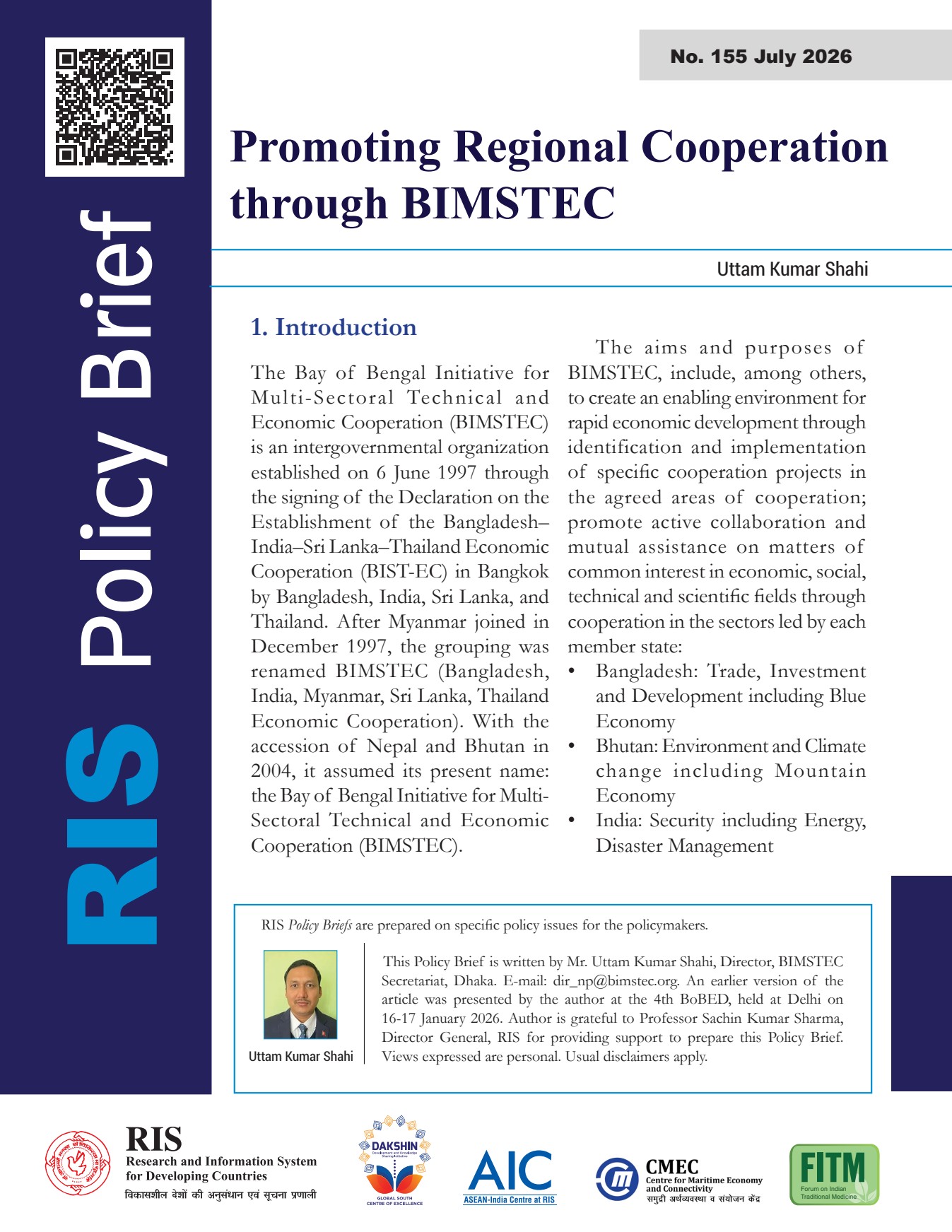
RIS No. 155 July 2026 Promoting Regional Cooperation through BIMSTEC This Policy Brief is written by Mr. Uttam Kumar Shahi, Director, BIMSTEC Secretariat, Dhaka. E-mail: [email protected]. An earlier version of the article was presented by the author at the 4th BoBED, held at Delhi on 16-17 January 2026. Author is grateful to Professor Sachin Kumar Sharma, Director General, RIS for providing support to prepare this Policy Brief. Views expressed are personal. Usual disclaimers apply. Policy Brief Uttam Kumar Shahi Uttam Kumar Shahi RIS Policy Briefs are prepared on specific policy issues for the policymakers. FITM Forum on Indian Traditional Medicine 1. Introduction The Bay of Bengal Initiative for Multi-Sectoral Technical and Economic Cooperation (BIMSTEC) is an intergovernmental organization established on 6 June 1997 through the signing of the Declaration on the Establishment of the Bangladesh– India–Sri Lanka–Thailand Economic Cooperation (BIST-EC) in Bangkok by Bangladesh, India, Sri Lanka, and Thailand. After Myanmar joined in December 1997, the grouping was renamed BIMSTEC (Bangladesh, India, Myanmar, Sri Lanka, Thailand Economic Cooperation). With the accession of Nepal and Bhutan in 2004, it assumed its present name: the Bay of Bengal Initiative for Multi- Sectoral Technical and Economic Cooperation (BIMSTEC). The aims and purposes of BIMSTEC, include, among others, to create an enabling environment for rapid economic development through identification and implementation of specific cooperation projects in the agreed areas of cooperation; promote active collaboration and mutual assistance on matters of common interest in economic, social, technical and scientific fields through cooperation in the sectors led by each member state: • Bangladesh: Trade, Investment and Development including Blue Economy • Bhutan: Environment and Climate change including Mountain Economy • India: Security including Energy, Disaster Management
Source page 2
2 RIS Policy Brief # 155 • Myanmar: Agriculture and Food security including Fisheries and Livestock management • Nepal: People to people contact including Poverty Alleviation • Sri Lanka: Science, technology and innovation including Health and Human resource development • Thailand: Connectivity These areas of cooperation strongly support the Sustainable Development Goals (SDGs)1. BIMSTEC is the only regional organization linking South Asia and Southeast Asia. Its member states are home to more than 1.8 billion people, accounting for 22 per cent of the world’s population. Together, they recorded a combined GDP of US$ 5.09 trillion in 2024 and external trade worth US$ 1.88 trillion in 2023. The BIMSTEC Secretariat, based in Dhaka, has been operational since September 2014. BIMSTEC adopted its charter during its 5 thSummit in Colombo in March 2022. The recently held 6 th Summit in Bangkok in April 2025, adopted the BIMSTEC Bangkok Vision 2030 along with the Summit declaration. The summit also adopted the report of Eminent Persons Group (EPG) on the future direction of BIMSTEC. The current chair of BIMSTEC is Bangladesh. 2. Salience of Regional Cooperation in the Bay of Bengal Region BIMSTEC member states face common challenges such as climate change, natural disasters, food security, connectivity gaps, and transnational security threats. These challenges are transboundary in nature which cannot be solved by one country acting alone, and, therefore, need coordinated and consolidated collaboration to tackle these challenges2.At the same time, BIMSTEC member states benefit from shared geography, historical and civilizational linkages, and shared cultural heritage, which provide a strong foundation for cooperation. Importantly, regional cooperation under BIMSTEC complements and strengthens the efforts to advance the existing bilateral relations between countries. 2.1 Progress in the Areas of Cooperation Over the years BIMSTEC has been making gradual progress in different sectors and sub-sectors, and this isbriefed here. Trade, Investment and Development Member states signed the Framework Agreement on the BIMSTEC Free Trade Area in 2004. Since then, six separate working groups have been negotiating the constituent agreements covering trade in goods, trade in services, investment, dispute settlement, customs cooperation, and trade facilitation. A proposal to establish a BIMSTEC Chamber of Commerce is also under consideration by the member states. More recently, Expert Groups on Fiscal and Monetary Policy and on the Blue Economy have been established. 1 Also refer, BIMSTEC Secretariat (2025b) 2 Refer, for example, De (2024)
Source page 3
3 RIS Policy Brief # 155 Environment and Climate Change The Plan of Action for Environment and Climate Change is currently under implementation and comprises three priority areas, namely, biodiversity, waste management, and climate change. In support of these efforts, the BIMSTEC Centre for Weather and Climate in Noida, India, has been assisting member states through tailored weather forecasts, early warning services, and capacity-building support. In addition, the Plan of Action on Mountain Economy has been finalized by the Inter-Governmental Expert Group on Mountain Economy, outlining five priority areas, namely, developing compact mountain settlements; enhancing mountain connectivity; promoting clean renewable energy; protecting mountain environments and ensuring ecosystem services; and fostering mountain tourism and green agro- and forest-based enterprises. Security In the security sector, the BIMSTEC Convention on Cooperation in Counter Terrorism, Transnational Crime and Drug Trafficking has been under implementation since March 2021. Member states have signed the BIMSTEC Convention on Mutual Legal Assistance in Criminal Matters, which is currently under ratification. BIMSTEC has also finalized three important instruments: (i) the Guidelines for the Maritime Component of Humanitarian Assistance and Disaster Relief (HADR); (ii) the Guiding Principles for the Conduct of BIMSTEC Maritime Law Enforcement Agencies (MLEAs) during their interaction at sea; and (iii) the Guidelines for Coordinated Marine Oil Spill Response. In addition, four meetings of BIMSTEC National Security Chiefs/Advisers have been held, and the fifth meeting is scheduled to be hosted by India in 2026. BIMSTEC has further been accorded observer status in the Asia/Pacific Group on Money Laundering. Disaster Management Member states have conducted several rounds of the BIMSTEC Disaster Management Exercise to strengthen regional preparedness and coordination in disaster response. In this context, India has initiated steps to establish a BIMSTEC Centre of Excellence in Disaster Management. The Centre is expected to provide consolidated and coordinated support to Member States during disasters by facilitating a synergized regional response. In addition, a Plan of Action has been finalized with the objective of ensuring a coordinated and collective BIMSTEC response to disasters in the region. Energy The Memorandum of Understanding on the Establishment of the BIMSTEC Grid Interconnection has been in force since April 2019, and the BIMSTEC Grid Interconnection Master Plan is currently being finalized with the support of the Asian Development Bank. To institutionalize cooperation in the energy sector, the BIMSTEC Energy Centre (BEC) has been established in Bengaluru, India, and is expected to develop into a Centre of Excellence in
Source page 4
4 RIS Policy Brief # 155 energy-related matters by promoting experience-sharing and capacity- building among Member States. Agriculture and Food Security Member states are implementing the Plan of Action on strengthening BIMSTEC agricultural cooperation under which initiatives such as agriculture scholarship programmes, capacity building workshops, etc. are being implemented. The third BIMSTEC Agricultural Ministerial meeting, held in April 2025 in Kathmandu, adopted the Plan of Action on Fisheries and Livestock and considered significant initiatives such as establishment of BIMSTEC Food Reserve; creation of a BIMSTEC Seed Bank; promotion of regional trade in agricultural commodities and creation of a Sub-group under Expert Group of Agricultural Cooperation on Intra- regional Agricultural Trade. People to People Contacts This sector comprises cooperation in areas enhancing people to people relations within the Bay of Bengal region. In the area of tourism, landmark ministerial-level outcomes such as the Kolkata Declaration of 2005 and the Kathmandu Declaration of 2006 have laid the foundation for sustained cooperation. These declarations led to concrete initiatives, including the establishment of the BIMSTEC Tourism Information Centre in New Delhi and the creation of the BIMSTEC Tourism Fund.To strengthen stakeholder engagement, BIMSTEC has established a Network of Tour Operators, bringing together both public and private tourism organizations from member states. BIMSTEC is also developing Tourism Circuits , most notably Buddhist Circuits, which leverage the region’s shared cultural and spiritual heritage. The Paro initiative, adopted by the Cultural Affairs Ministerial meeting held in Paro, Bhutan in May 2006,set the foundation of cultural cooperation among the member states including the establishment of BIMTEC Cultural Industries Observatory (BCIO) in Bhutan. To enhance parliamentary engagement, aBIMSTEC Parliamentarians Forumis currently being set up.The BIMSTEC Network of Policy Think Tanks,that bringstogether seven leading think tanks, one from each member State, has been playing an important role in providing policy options and recommendations to strengthen cooperation, regional integration, and the future direction of BIMSTEC. Youth conclaves and sports events are being organized regularly to encourage interaction among young people and to build a shared regional identity. India has organized number of events in the year 2025 such as Young Leaders’ Summit, Training for Yoga Trainers, Young Professional Exchange Programme, etc. In addition, the BIMSTEC Expert Group on Visa Matters has also been discussing measures aimed at improving ease of travel and facilitating greater mobility across the region. The recent meeting of the expert group has finalized a BIMSTEC visa facilitation scheme.
Source page 5
5 RIS Policy Brief # 155 An Action Plan on Poverty Alleviation is being implemented. Capacity building workshops, including the exchange of best practices amongst the member states in the areas of poverty alleviation,are being organised. Science, Technology and Innovation The Plan of Action (2023–2027) on cooperation in science, technology and innovation is under implementation. BIMSTEC Technology Transfer Facility is being set up in Colombo which is expected to coordinate, facilitate and strengthen the technology transfer among the BIMSTEC member states. Likewise, realizing the benefits of Digital Public Infrastructure (DPI), BIMSTEC is increasingly focused in promoting collaboration among the member States in this sector seeking support of external partners. Health The Plan of Action on Health Cooperation is currently under implementation. The World Bank– supported project on Strengthening Pandemic Prevention, Preparedness and Response and Health Systems Resilience, involving five member States, is under implementation. Thailand has proposed the establishment of a BIMSTEC Centre of Excellence on Tropical Medicine. A BIMSTEC Task Force on Traditional Medicine has been set up. 3 Member states are working to develop a BIMSTEC Traditional Medicine Portal and the sharing of pharmacopoeia of the BIMSTEC member states. India has proposed the establishment of a BIMSTEC Centre of Excellence in Traditional Medicine. Human Resource Development The BIMSTEC Plan of Action on Human Resource Development focusing on capacity building, skills enhancement and education cooperation is under implementation. Bangladesh has offered to set up a Centre of Excellence for Skill Development. Member states are also considering establishing an Expert group on Women Development. Connectivity The BIMSTEC Master Plan for Transport Connectivity, adopted at the 5 th BIMSTEC Summit in 2022 in Colombo, aims to enhance physical, digital, and people-to-people connectivity across the region. Member states during the 6th Summit signed the BIMSTEC Agreement on Maritime Transport Cooperation aiming to enhance maritime partnerships in the region. 4 Likewise, member states are negotiating the BIMSTEC Motor Vehicles Agreement, which aims for facilitating smoother movement of goods and passengers among the member States. Existing BIMSTEC Centres BIMSTEC member states have set up four centres of excellence in the region: • BIMSTEC Centre for Weather and Climate (BCWC), India; • BIMSTEC Energy Centre (BEC), India; • BIMSTEC Cultural Industries Observatory (BCIO), Bhutan (in the process of operation); and • BIMSTEC Technology Transfer Facility, Sri Lanka (in the process of operation). 3 Refer, for example, BIMSTEC Secretariat (2025b) 4 Refer, BIMSTEC Secretariat (2025c), ADB and BIMSTEC Secretariat (2020), ADB and BIMSTEC Secretariat (2022).
Source page 6
6 RIS Policy Brief # 155 Relations with External Partners BIMSTEC has signed MOUs for cooperation with Asian Development Bank (ADB), Indian Ocean Rim Association (IORA), International Food Policy Research Institute (IFPRI), UN Office on Drugs and Crime (UNODC) and is considering signing with some other organizations in line with the interests and priorities of BIMSTEC. Several workshops and capacity building programs are being organized by BIMSTEC in coordination with and support of these external partners throughout the year, while opportunities for project-based collaborations are being explored. 3. Key Challenges and Prospects In its nearly three decades of institutional journey, BIMSTEC has been facing some challenges, such as ensuring the timely convening of summits, ministerial and other regular meetings of its core and sectoral mechanisms. Likewise, the multi-layered decision-making process, approval and reporting process also cause delays and makes decision making time-consuming. Furthermore, the implementation of Master Plans and Plans of Action across different areas of cooperation largely depends on the institutional and technical capacities of individual member states, which may differ among countries. There is also the need for adequate attention and prioritization of BIMSTEC-related matters within the ministries and relevant agencies in member states. Building convergence and consensus remains challenging due to the diverse levels of economic development among the member states, which can lead to differing priorities and expectations. Despite challenges, BIMSTEC is well positioned to emerge as a leading regional organization. BIMSTEC pursues regional cooperation in the strategically vital Bay of Bengal region and uniquely brings together seven countries from South Asia and Southeast Asia together. BIMSTEC enjoys the requisite political support of its member States, maintains a clear focus on tangible and practical cooperation, and stays away from divisive political issues. As a result, BIMSTEC has not been adversely affected by political developments within the member states. The Eminent Persons Group (EPG) Report, adopted at the 6 thSummit, provides recommendations aiming to reform, revitalize and repurpose BIMSTEC. The implementation of the recommendations has already been initiated. The BIMSTEC agenda is both comprehensive and balanced, addressing security challenges alongside sustainable development priorities, reflecting the real needs of the region. A wide range of United Nations entities, international, and regional organizations have expressed willingness to engage with BIMSTEC in promoting development, prosperity, and cooperation in the Bay of Bengal region. Taken together, these factors underscore BIMSTEC’s strong potential to play a transformative role in regional cooperation and integration in the Bay of Bengal region
Source page 7
7 RIS Policy Brief # 155 4. Conclusions BIMSTEC acts as a critical bridge between South and Southeast Asia, bridging five South Asian and two Southeast Asian nations. Realizing the group's potential requires accelerating trade pacts and strengthening transport connectivity to foster economic growth. The overarching conclusions surrounding BIMSTEC's cooperative framework highlight both significant potential and persistent developmental hurdles. Regional integration in BIMSTEC has witnessed good progress over time. References ADB and BIMSTEC Secretariat (2020) BIMSTEC Master Plan of Transport Connectivity, Manila and Dhaka, ava ilable at https://bimstec.org/images/publication_pdf_file/1696657459_BIMSTEC_ Master%20Plan%20for%20Transport%20Connectivity.pdf ADB and BIMSTEC Secretariat (2022) BIMSTEC Trade Facilitation Strategic Framework, Manila and Dhaka, available at https://bimstec.org/images/publication_pdf_file/1696657869_bimstec-trade- facilitation-strategic-framework-2030%20(1).pdf BIMSTEC Secretariat (2025a) BIMSTEC: A Bridge between South Asia and Southeast Asa, Dhaka, available at https://bimstec.org/images/publication_pdf_file/1766469649_BIMSTEC%20 Brochure%20%20%202025.pdf BIMSTEC Secretariat (2025b) Traditional Medicine Systems of BIMSTEC Member States, Dhaka, available at https://bimstec.org/images/publication_pdf_file/1696658038_TM-in-BIMSTEC- Eng-only.pdf BIMSTEC Secretariat (2025c) “Agreement on Maritime Transport Cooperation (AMTC)”Signed on 3 April 2025 at Bangkok, Dhaka, available at https://bimstec.org/agreements-conventions-mous De, Prabir (2024)“Accelerating Regional Cooperation in BIMSTEC”, Policy Brief No. 5, CMEC at RIS, New Delhi, available at https://www.ris.org.in/sites/default/files/Publication/PB-5%20Dr%20 Prabir%20De.pdf RIS Policy Briefs PB#152-2026 India’s AI-Enabled Bharat VISTAAR Platform: Lessons for Bridging Agricultural Information Gap in Sub-Saharan Africa by Dr. Pratap S Birthal, Prof. Sachin Kumar Sharma and Ms. Tanya Singh PB#151-2026 Advancing India Africa Blue Economy Cooperation by Dr. Pankhuri Gaur and Mr. Ayush Tiwari PB#150-2026 India-Africa Standards and Regulations: Shared Challenges and Mutual Learning by Mr. Anil Jauhri, Mr. Jamshed Ahmad Siddiqui and Ms. Om Stutee PB#149-2026 India's Drive Towards Paperless Trade: Recent Developments and the Way Forward by Dr. Arpita Mukherjee , Dr. Prabir De, Dr. Pritam Banerjee and Ms. Geetika Gupta PB#148-2026 Fourth India-Africa Forum Summit Policy Brief: Leveraging India- led global initiatives for India-Africa Partnership by Sabyasachi Saha and Rugmini Devi M PB#147-2026 The War in Gulf and What It Means for India’s Trade and Trade Facilitation by Prabir De, Adrija Ganguly and Srinivas Rao
Source page 8
AIC at RIS has been working to strengthen India’s strategic partnership with ASEAN in its realisation of the ASEAN Community. AIC at RIS undertakes research, policy advocacy and regular networking activities with relevant organisations and think-tanks in India and ASEAN countries, with the aim of providing policy inputs, up-to-date information, data resources and sustained interaction, for strengthening ASEAN-India partnership. The word “DAKSHIN” ( nf{k.k½ is of Sanskrit origin, meaning “South.” The Hon’ble Prime Minister of India, Shri Narendra Modi, inaugurated DAKSHIN – Global South Centre of Excellence in November 2023. The initiative was inspired by the deliberations of Global South leaders during the Voice of the Global South Summits. DAKSHIN stands for Development and Knowledge Sharing Initiative. Hosted at the RIS, DAKSHIN has established linkages with leading think tanks and universities across the Global South and is building a dynamic network of scholars working on Global South issues. RIS specialises in issues related to international economic development, trade, investment and technology. It is envisioned as a forum for fostering effective policy dialogue and capacity-building among developing countries on global and regional economic issues. The focus of the work programme of RIS is to promote South-South Cooperation and collaborate with developing countries in multilateral negotiations in various forums. Through its following centres/forums, RIS promotes policy dialogue and coherence on regional and international economic issues. CMEC has been established at RIS under the aegis of the Ministry of Ports, Shipping and Waterways (MoPS&W), Government of India. CMEC is a collaboration between RIS and Indian Ports Association (IPA). It has been mandated to act as an advisory/technological arm of MoPSW to provide the analytical support on policies and their implementation. FITM is a joint initiative by the Ministry of Ayush and RIS. It has been established with the objective of undertaking policy research on economy, intellectual property rights (IPRs) trade, sustainability and international cooperation in traditional medicines. FITM provides analytical support to the Ministry of Ayush on policy and strategy responses on emerging national and global developments. FITM Forum on Indian Traditional Medicine FISD aims to harness the full potential and synergy between science and technology, diplomacy, foreign policy and development cooperation in order to meet India’s development and security needs. It is also engaged in strengthening India’s engagement with the international system and on key global issues involving science and technology. Forum for Indian Science DiplomacyFISD BEF aims to serve as a dedicated platform for fostering dialogue on promoting the concept in the Indian Ocean and other regions. The forum focuses on conducting studies on the potential, prospects and challenges of blue economy; providing regular inputs to practitioners in the government and the private sectors; and promoting advocacy for its smooth adoption in national economic policies. BLUE ECONOMY FORUM BEF As part of its work programme, RIS has been deeply involved in strengthening economic integration in the South Asia region. In this context, the role of the South Asia Centre for Policy Studies (SACEPS) is very important. SACEPS is a network organisation engaged in addressing regional issues of common concerns in South Asia. Knowledge generated endogenously among the Southern partners can help in consolidation of stronger common issues at different global policy fora. The purpose of NeST is to provide a global platform for Southern Think-Tanks for collaboratively generating, systematising, consolidating and sharing knowledge on South South Cooperation approaches for international development. DST-Satellite Centre for Policy Research on STI Diplomacy at RIS aims to advance policy research at the intersection of science, technology, innovation (STI) and diplomacy, in alignment with India’s developmental priorities and foreign policy objectives. FIDC, has been engaged in exploring nuances of India’s development cooperation programme, keeping in view the wider perspective of South-South Cooperation in the backdrop of international development cooperation scenario. It is a tripartite initiative of the Development Partnership Administration (DPA) of the Ministry of External Affairs, Government of India, academia and civil society organisations. DST SPR Department of Science and Technology Satellite Centre for Policy Research at RIS STI Diplomacy Core IV-B, Fourth Floor, India Habitat Centre, Lodhi Road, New Delhi-110 003, India., Tel. 91-11-24682177-80, Email: [email protected], Website: www.ris.org.in — Policy research to shape the international development agenda — www.facebook.com/risindia @RIS_NewDelhi www.youtube.com/RISNewDelhi Follow us on: